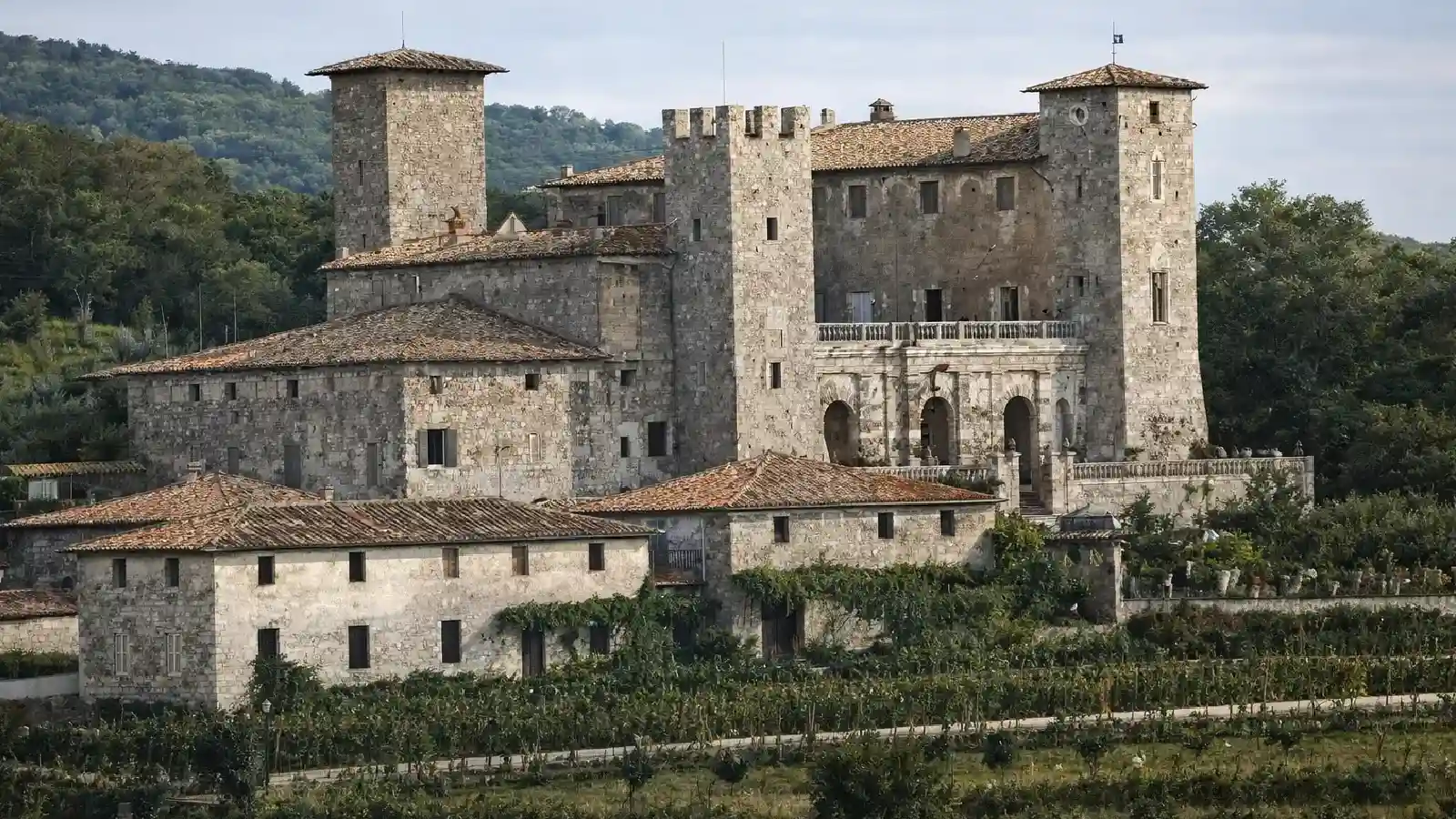
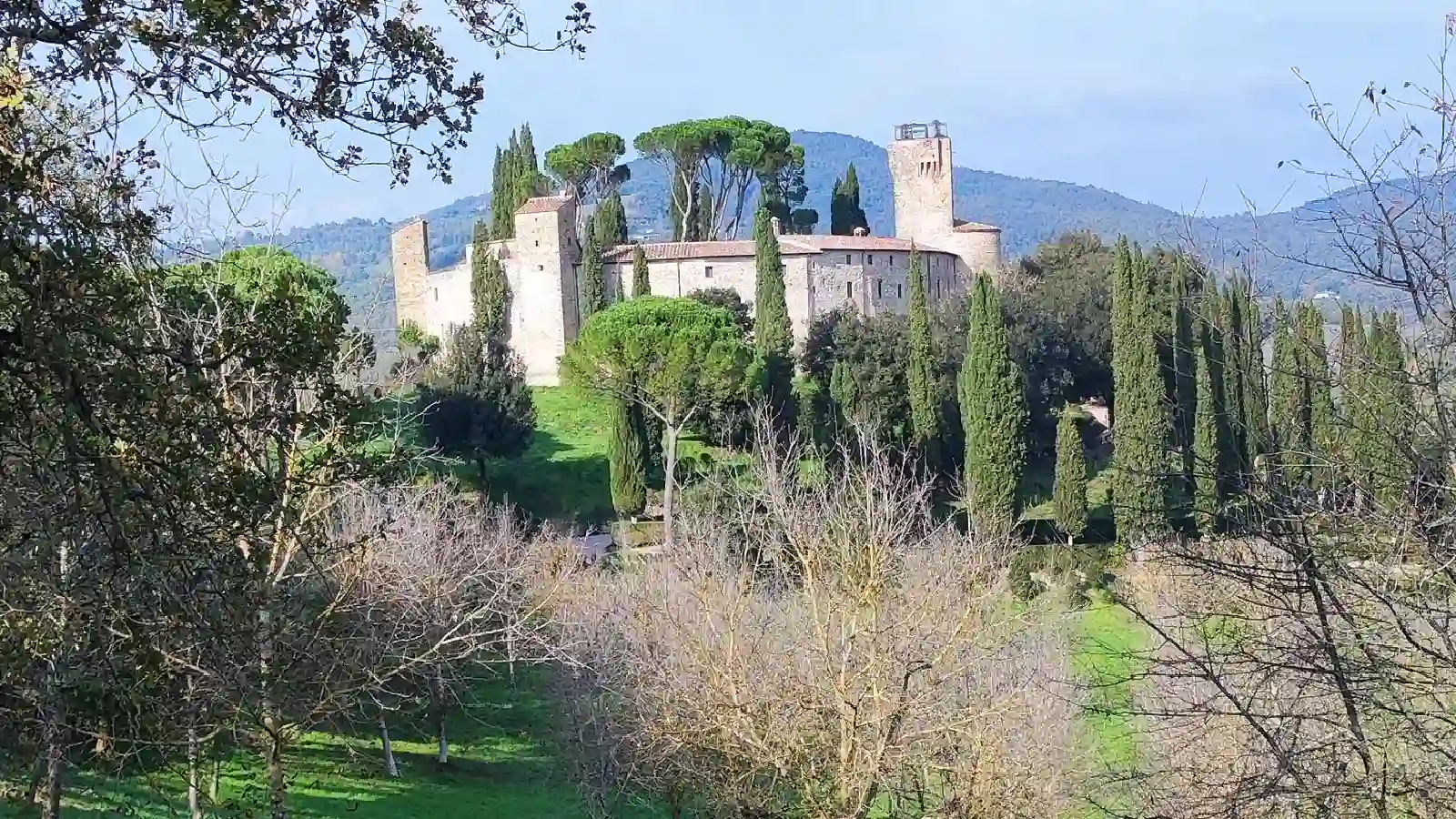
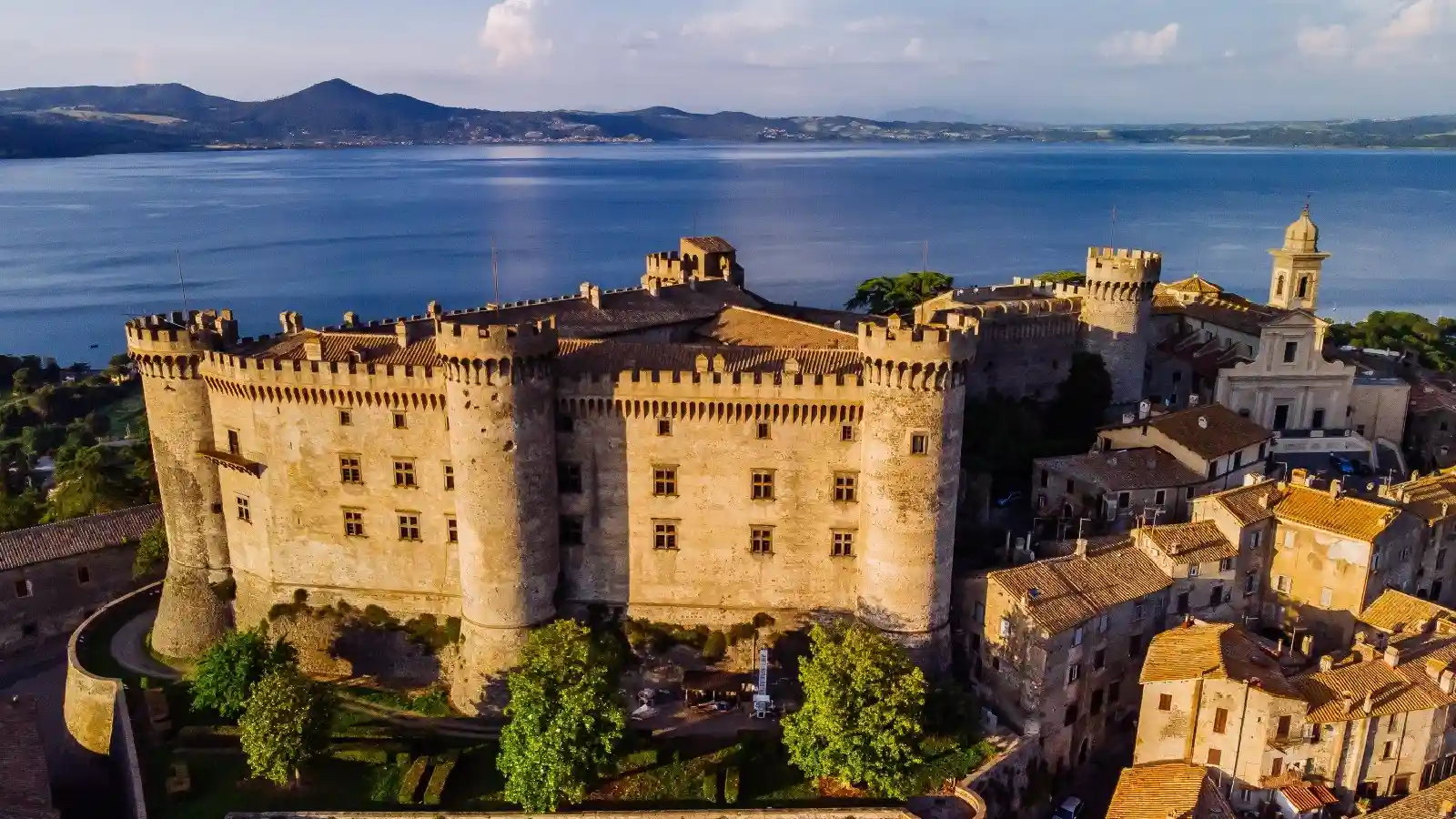
The Noble Castle: A Fortified Residence
The first category is the castle conceived, or later developed, as the residence of a lord, noble family or ruling court.
These were not merely defensive structures.
They were also homes, places of representation, places where guests were received, decisions were taken, banquets held and court life unfolded.
Their architecture could therefore combine defensive features with a more sophisticated residential character.
- Large halls and saloni
- Loggias and courtyards
- Private chapels
- Decorated rooms and frescoes
- Tapestries and fireplaces
- Formal gardens added in later centuries
Their proportions and interior decoration may reveal the transition from medieval fortification to aristocratic residence.
For weddings, these castles often allow a particularly elegant interpretation.
Their historic identity remains strong, but ceremonial and residential rooms can accommodate a more formal, sophisticated event.
They can be romantic without becoming theatrical.
Historic without necessarily feeling austere.
The Fortress: Architecture Created for Defence
The second type is very different.
A rocca, stronghold or military fortress was designed primarily to defend territory.
Its logic was strategic rather than residential.
- Thick walls and watchtowers
- Limited entrances
- Defensive courtyards
- Battlements and elevated positions
- Spaces designed for soldiers rather than a court
- Often limited service infrastructure
These structures can have extraordinary visual power precisely because of their austerity.
Their architecture communicates protection, permanence, strength and isolation.
From an event point of view they require intelligence.
Rooms may be smaller, access difficult, stairs narrow and electrical infrastructure limited.
Large formal salons may simply not exist.
A fortress therefore asks for a completely different wedding design from an aristocratic castle.
Trying to transform it into a ballroom palace usually works against the building.
Working with its stone, courtyards, towers, walls and strong architectural geometry can instead produce something exceptional.
The Fortified Village
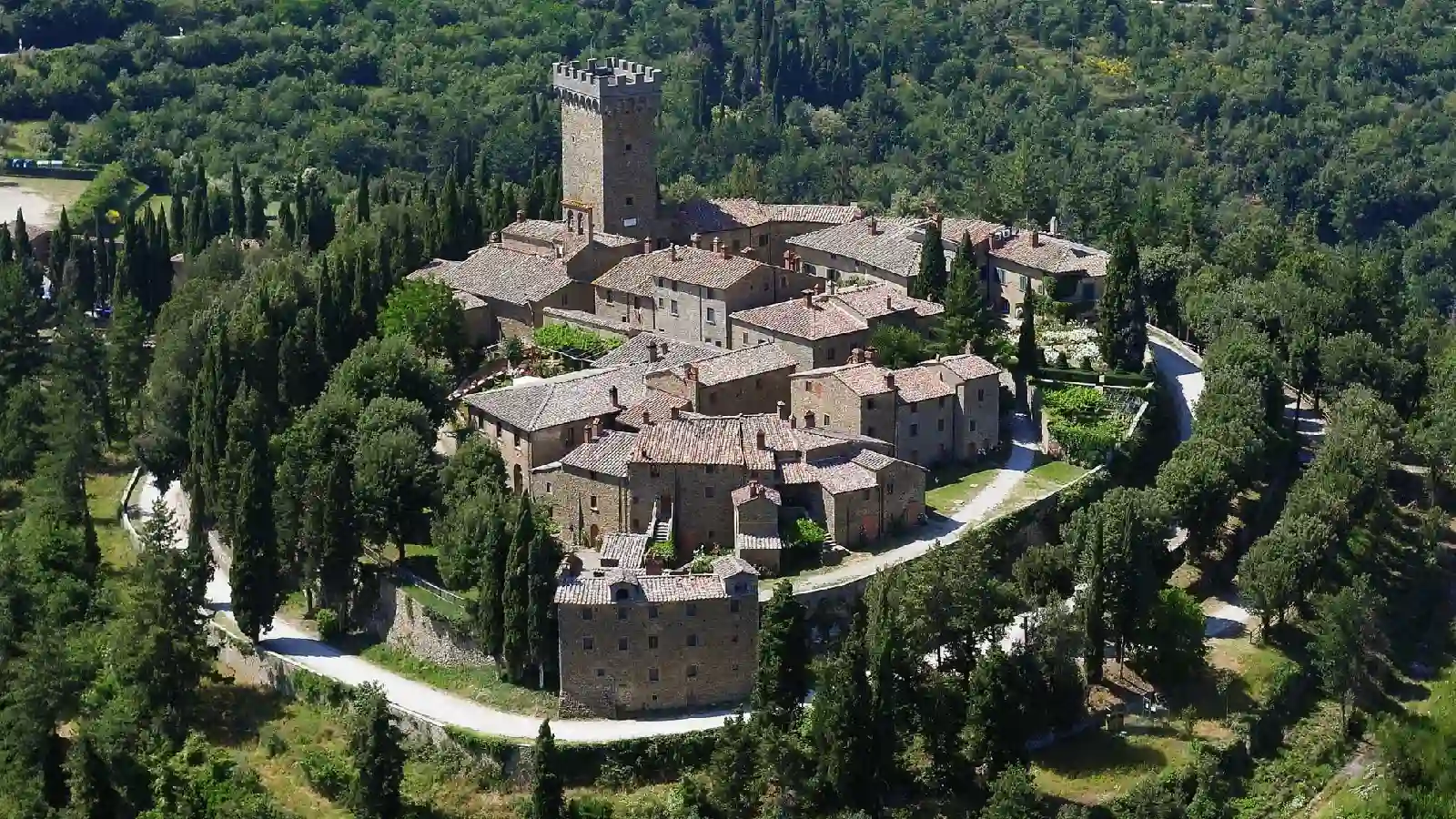
The third category is perhaps the most fascinating because what we call a “castle” may actually be an entire fortified borgo.
Historically, walls were constructed around a small settlement to protect the population.
Inside there might be homes, streets, workshops, a church, a central square and the residence of the local authority.
The result is not one building.
It is a small world.
Castello di Gargonza in Tuscany is a particularly clear example of this typology.
It is a medieval fortified village in which the historic urban fabric survives inside the defensive enclosure.
For a wedding, this creates a completely different experience.
Guests can move through streets and squares rather than simply from room to room.
Accommodation may be distributed throughout the village.
The church may already belong naturally to the setting.
Welcome dinners, wedding celebrations and breakfasts can occupy different areas.
For a destination wedding extending over several days, the fortified village can create an extraordinary sense of privacy and community.
One Word, Three Different Wedding Experiences
These distinctions explain why selecting a castle simply because one “wants a castle wedding” is not enough.
A noble residence can suggest elegance, candlelight, historic interiors and courtly proportions.
A fortress may call for stronger architecture, dramatic lighting, stone, fire and a more essential design language.
A fortified village can become an immersive destination experience where guests appear to inhabit an entire historic settlement.
None is intrinsically better than the others.
They simply tell different stories.
The Genius Loci of a Castle
Few locations impose their personality as strongly as a castle.
A neutral ballroom can be redesigned almost completely.
A medieval castle cannot — and should not — be treated in the same way.
Its walls, towers, courtyards, proportions and history already communicate something before a single flower is placed.
This intrinsic identity is what we mean by the genius loci.
At P&J Events, we believe the design of a castle wedding should enter into dialogue with that identity.
Sometimes this means historical harmony.
Sometimes a very contemporary intervention can create an extraordinary contrast.
But the contrast should be conscious.
A venue with such a powerful character should never become merely a background hidden beneath decoration.
Romantic Castles, Fortresses and Fortified Villages
The emotional effect can differ enormously from castle to castle.
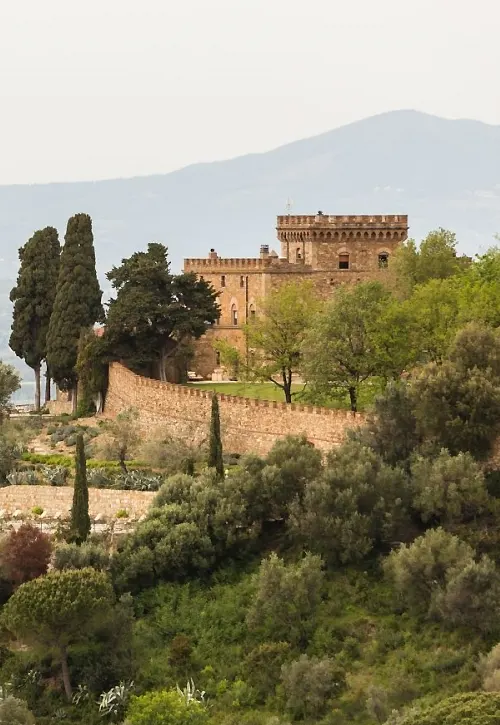
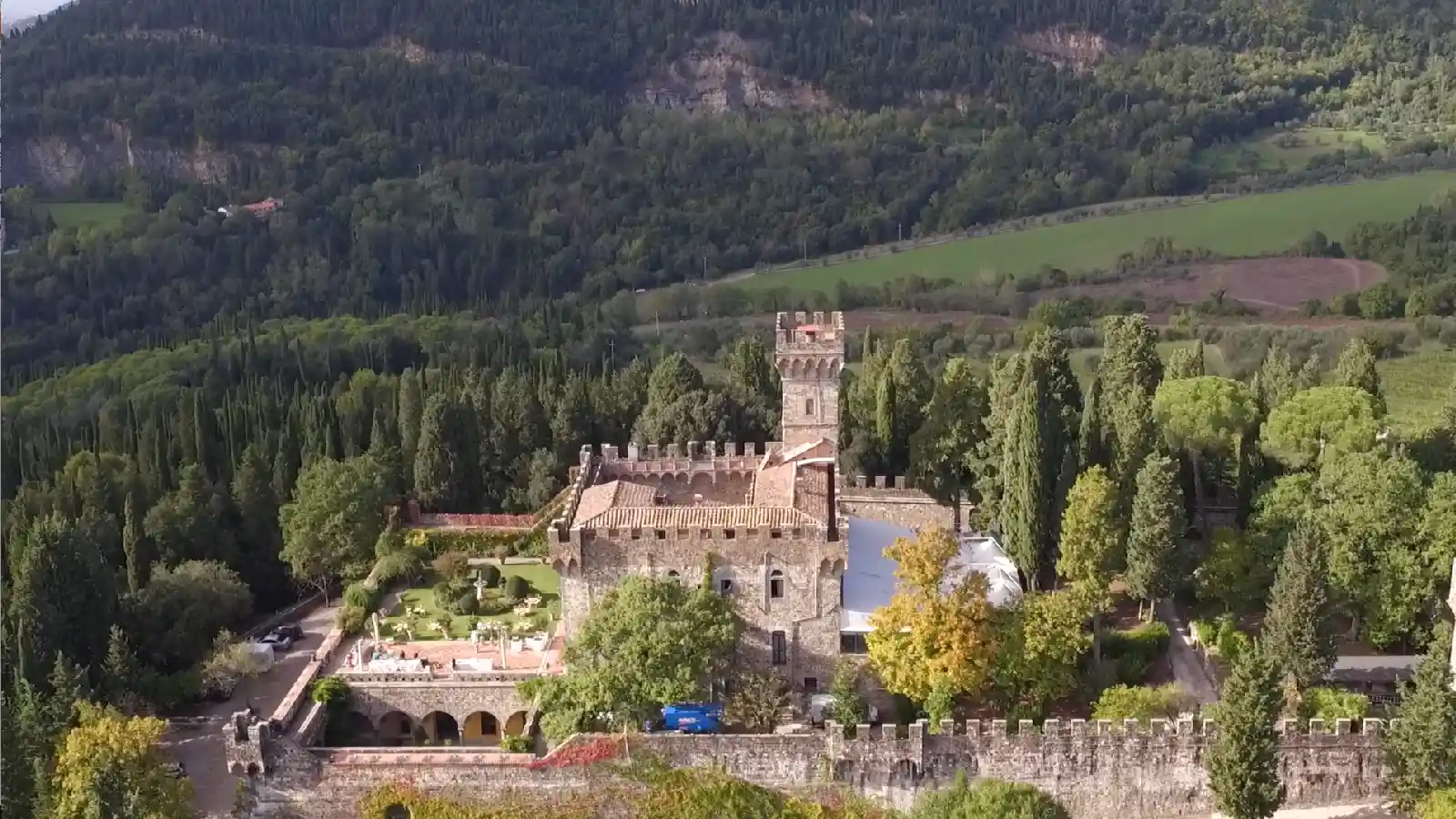
Castello di Vincigliata, above Florence, has an unmistakably romantic and almost fairytale quality.
Its stone architecture, courtyard and surrounding landscape naturally suggest a highly atmospheric wedding.
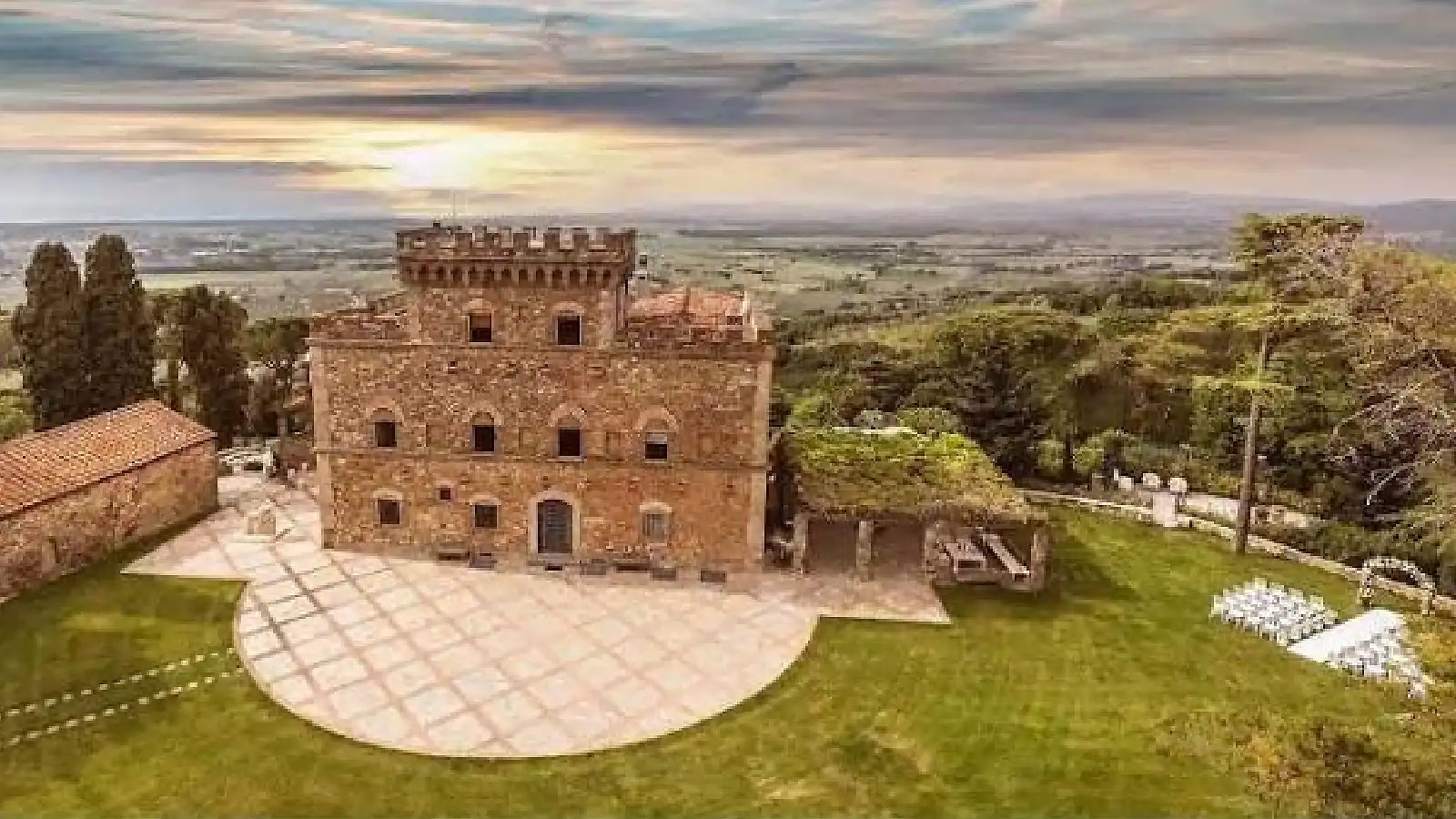
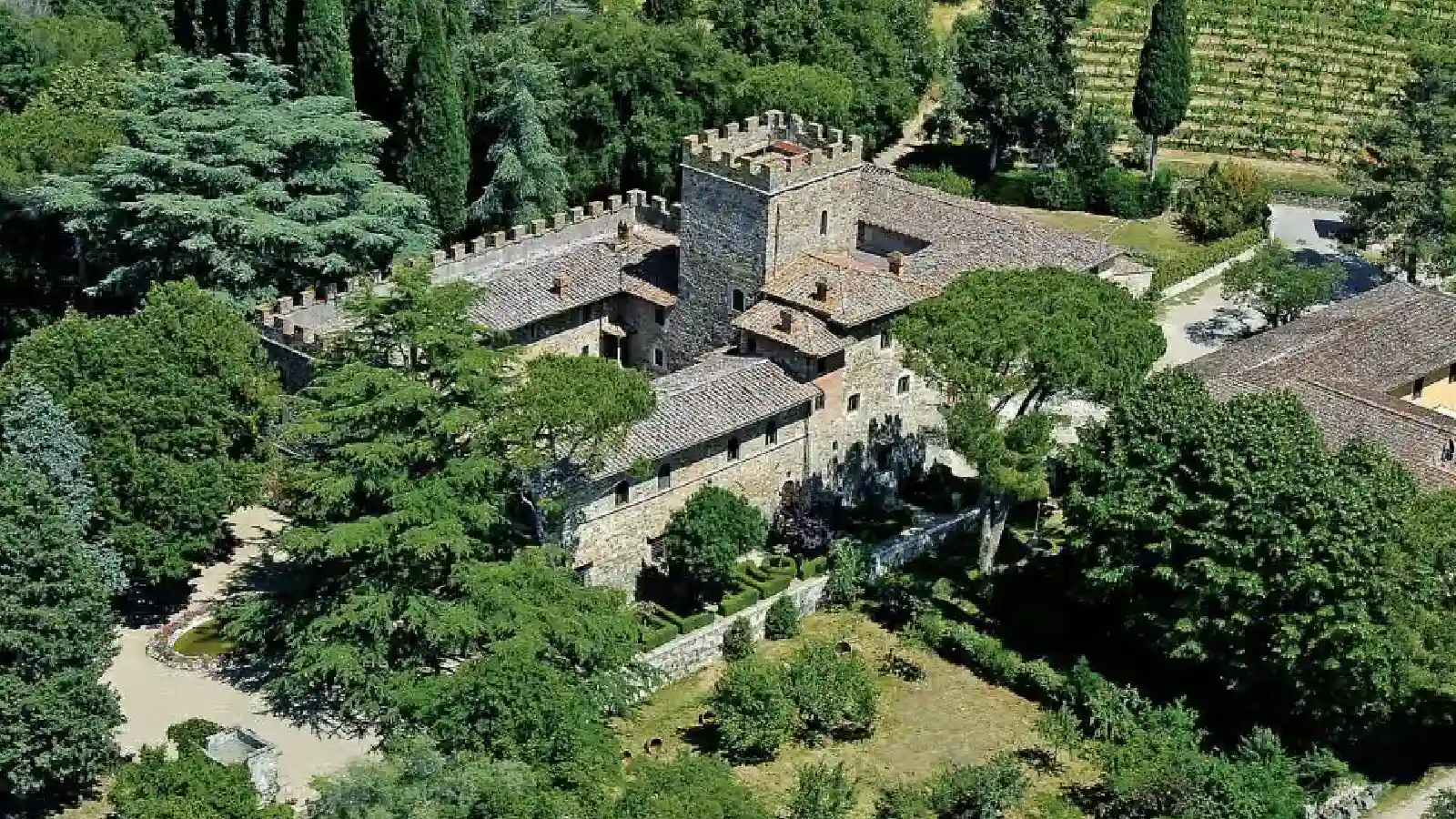
Castello Il Palagio has a different character.
Its history is closely connected with fortification and defence, and its substantial walls and tower communicate the strength of a historic stronghold.
Gargonza gives yet another sensation.
The experience derives from entering a complete fortified settlement rather than a single monumental residence.
Understanding these differences is part of selecting the right setting.
Castles from Trentino to Sicily
Italy's castle heritage is not limited to Tuscany or the area around Rome.
Castles, rocche, fortified villages and noble residences can be found throughout the country.
- Trentino-Alto Adige
- Piedmont
- Lombardy
- Veneto
- Friuli
- Emilia-Romagna
- Tuscany
- Umbria
- Lazio
- Abruzzo
- Campania
- Puglia
- Basilicata
- Calabria
- Sicily
- Sardinia
The architecture changes with geography, political history, military requirements and local culture.
A northern Alpine castle cannot be approached aesthetically in the same way as a Sicilian fortified residence or a Tuscan stronghold.
This variety is part of what makes Italy exceptional for castle weddings.
Analysing a Castle from a Logistical Point of View
The romantic image is only the beginning.
Castles are among the venues that most require serious technical analysis.
They were constructed for functions that had nothing to do with contemporary weddings.
This immediately affects the practical organization of the event.
For P&J Events, the question is therefore never simply: “Is the castle beautiful?”
We need to know: Can this particular castle support this particular wedding?
Large Indoor Spaces Are Not Guaranteed
One of the first misunderstandings concerns capacity.
A castle may appear enormous from outside and yet have no single interior room capable of seating 150 or 200 guests.
Historically, the property may have been divided into many smaller rooms serving completely different purposes.
- Bedrooms
- Guard rooms
- Private halls
- Storage rooms
- Chapels
- Service areas
- Military spaces
The overall size of the building therefore tells us very little about its effective wedding capacity.
A castle for 200 guests must be analysed much more carefully than a purpose-built modern event venue.
Plan B: Perhaps the Most Important Question
For this reason, Plan B is one of the first subjects P&J Events studies.
A courtyard capable of seating 200 people beautifully does not represent an adequate venue for 200 guests if the largest indoor room only seats 90.
In many castles, a professionally designed marquee, pavilion or greenhouse can be the correct solution.
This should not necessarily be considered a compromise.
When designed properly, a temporary structure can become part of the architecture of the wedding.
It can protect the event from rain without sacrificing the relationship with the castle.
But it must be considered from the beginning.
Greenhouses and Temporary Structures
Some castles have magnificent gardens or courtyards but insufficient covered capacity.
Here a greenhouse-style pavilion can be particularly successful.
Transparent structures can retain the visual relationship with walls, towers or landscape while providing a controlled event environment.
This solution can also allow lighting, sound, flooring and climate control to be designed specifically for the wedding.
The important point is that the temporary architecture should respond to the historic architecture rather than compete with it.
Bathrooms in a Castle
Bathrooms are another frequently underestimated issue.
A private castle may have elegant bathrooms appropriate for residential use but completely inadequate for 150 or 250 guests over many hours.
Historic plumbing systems may also have limitations.
In these circumstances, high-quality temporary restroom facilities are not a secondary detail.
They are professional infrastructure, and their location, access, lighting, water and maintenance should be integrated discreetly into the event plan.
Catering in a Castle
The catering operation deserves particular attention.
Many castles either have no professional kitchen or have kitchens that were never designed to serve hundreds of guests simultaneously.
Professional caterers may therefore need to bring almost everything.
- Cooking equipment
- Refrigeration
- Preparation tables
- Ovens
- Dishwashing
- Water systems
- Service equipment
- Sometimes a complete temporary kitchen
Because P&J Events also understands catering from the inside, we assess this part of the venue very carefully.
A beautiful dinner setting has little value if the catering team cannot reach it efficiently or maintain service quality.
Independent Power and Generators
Electrical systems in historic buildings should never simply be assumed capable of supporting a contemporary production.
Catering equipment, lighting, sound, bands, DJ systems, temporary kitchens, heating or cooling can all create substantial electrical demand.
Where appropriate, we consider an independent generator or backup power supply advisable.
This protects the wedding from unpleasant surprises and allows technical production to operate independently from delicate historic infrastructure.
The Wedding Flow
The flow of the wedding is particularly important inside a castle.
- Ceremony
- Cocktail
- Dinner
- Cake
- Dancing
Each transition should feel natural.
Castles often offer many visually compelling spaces, but those spaces may be on different levels, separated by stairs or connected through narrow passages.
The objective is not necessarily to use every beautiful corner.
It is to use the right spaces in the right sequence.
A well-designed flow can make the castle gradually reveal itself during the day.
A badly designed flow can leave guests walking unnecessarily long distances or repeatedly crossing operational areas.
Internal and External Spaces
Castle weddings are often strongest when architecture and outdoor space are considered together.
- A ceremony might take place in a garden
- Cocktails on the battlements
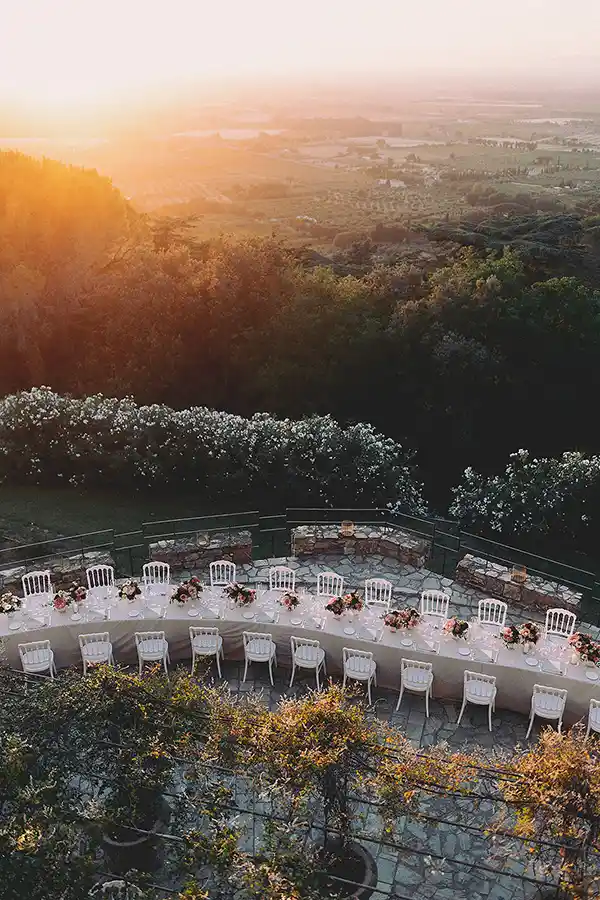
- Dinner in a courtyard
- Cake beneath a tower
- Dancing inside a vaulted room
- Or the sequence may be completely different
There is no standard formula.
It depends on what the castle actually offers.
A Castle Does Not Necessarily Need a View
Another interesting misconception concerns views.
Many couples expect a castle to have panoramic views from every part of the property.
Historically, this often makes little sense.
A watchtower needed a view.
Battlements needed a view.
Defensive walls needed visual control of the territory.
But an internal courtyard or protected garden did not necessarily need a panoramic outlook at all.
Some of the most beautiful castles therefore provide spectacular views from towers, walls or elevated positions but not from the areas in which dinner or dancing naturally take place.
This is not necessarily a weakness.
It simply requires another way of thinking.
Designing for the Internal World of the Castle
When the principal event spaces do not offer an external panorama, we often prefer to celebrate the castle's internal world.
- Stone walls
- Courtyards
- Arches
- Towers
- Trees
- Candlelight
- Architecture
Lighting can transform these environments after sunset.
Rather than constantly orienting the wedding toward a distant landscape, the event becomes immersed in the castle itself.
For the right property, this can be far more evocative than a conventional “view”.
Castles with Exceptional Views
Other castles offer both architecture and extraordinary landscape.
Castello di Segalari at Castagneto Carducci opens toward the Tuscan countryside and the sea.
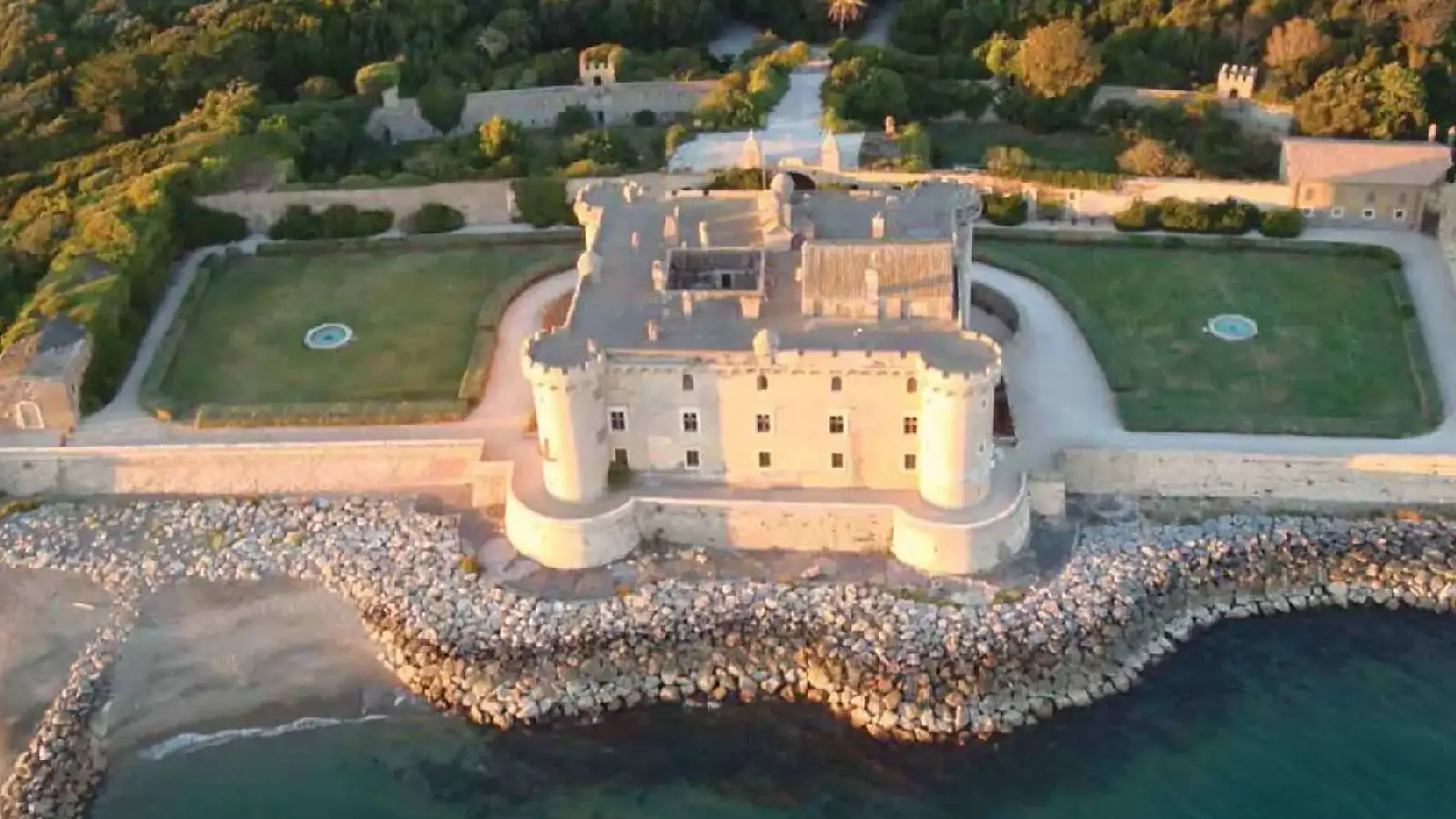
Castello Odescalchi di Palo stands directly on the Tyrrhenian coast, where a historic fortified residence meets the Mediterranean.
In these cases the landscape becomes one of the fundamental elements of the wedding.
The important distinction is that the view should be exploited because it genuinely belongs to the property — not because every castle is expected to have one.
Music Until Late
One surprising advantage of certain castles is their relationship with sound.
Some were deliberately isolated.
Others have extremely substantial walls.
In the right circumstances, these characteristics may make them particularly suitable for celebrations continuing late into the night.
This cannot be assumed.
Municipal regulations, neighbours and venue policies must always be checked.
But when a castle combines relative isolation, appropriate indoor spaces and tolerant regulations, it can provide something increasingly valuable in destination weddings.
The freedom to continue the party without destroying the atmosphere at an arbitrary early hour.
Civil Ceremonies with Legal Validity in Italian Castles
Some Italian municipalities have formally authorized particular private properties, including castles, as locations where official civil ceremonies may be celebrated.
That can make the administrative procedure particularly straightforward.
P&J Events, however, is not limited to a fixed catalogue of already designated venues.
Over decades of experience with international marriages in Italy, first during the Regency years and today under P&J Events, we developed professional knowledge of legal and administrative procedures.
Our objective is to allow the couple to celebrate the real legal ceremony in the castle they have actually chosen, rather than forcing them to select a venue simply because it already appears on a municipal list.
For this reason, P&J Events can examine the possibility of arranging a legally valid ceremony in any suitable private castle in Italy.
We work with the property and the competent authorities to establish the necessary procedure.
Where all applicable requirements can be satisfied, the ceremony produces immediate civil effects under Italian law rather than being merely symbolic.
For an international couple, the resulting Italian marriage can then be recognized abroad according to the rules of the country concerned.
Any legalization, apostille, transcription or registration formalities that apply must also be completed.
This distinction is important.
We are not proposing two ceremonies — one legal and one “real”.
Our objective, whenever the legal conditions allow it, is one ceremony, in the castle, with legal validity from the moment it is celebrated.
Protestant, Jewish and Symbolic Ceremonies
P&J Events can also coordinate Protestant weddings, Jewish weddings, non-denominational ceremonies and symbolic celebrations in castles throughout Italy.
Each ceremony requires its own approach.
- Religious authority
- Documentation
- Physical orientation
- Chuppah or ceremony structure
- Music
- Processional
- Private spaces
- Civil validity where applicable
A historic setting should support the meaning of the ceremony rather than become merely theatrical scenery.