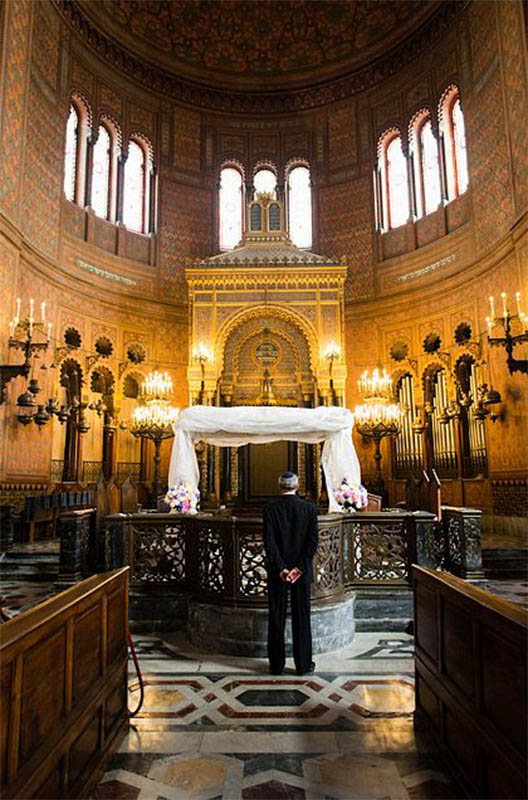
Jewish Wedding in Italy
A Deep Understanding of Jewish Religion, Culture and Wedding Traditions
For more than twenty years, our organization has been planning Jewish weddings in Italy for couples and families from around the world.
Today, under the P&J Events brand, that experience combines destination wedding planning with something equally important: a profound practical understanding of Jewish religious traditions, cultural identity, family customs and the different ways in which Judaism is lived across countries and communities.
A Jewish wedding is not simply an event containing a Chuppah, a Ketubah and a few recognizable traditions.
Every couple brings a different Jewish story.
Orthodox, Conservative, Reform, Progressive and Reconstructionist families may approach the ceremony differently.
Ashkenazi and Sephardi traditions may differ.
Israeli, American, British, French, Italian and other Jewish communities can bring different minhagim, expectations, melodies, culinary traditions and family customs.
Even within the same religious orientation, two families may understand and experience their Jewish identity in very different ways.
Our first responsibility is therefore to listen.
Before discussing the venue, flowers or design, we need to understand what Judaism means to the couple and their families, which traditions are essential to them, which customs belong to their personal history and which religious authority will guide the ceremony.
Only then can the wedding be planned correctly.

Our Dedicated Team for Jewish Weddings in Italy
P&J Events has organized Jewish celebrations in Italy for more than two decades, from intimate family weddings to complex international destination celebrations.
Our experience has developed through direct work with Rabbis, Jewish communities, synagogues, kosher caterers, Mashgihim, international families and specialist professionals.
Over time, this has given our team an unusually detailed understanding of the relationship between the religious ceremony and everything surrounding it.
We understand that the Chuppah cannot be considered simply as an aesthetic structure.
That a Ketubah is not simply a decorative document.
That kosher is not a style of cuisine.
That Shabbat affects timing and logistics.
That synagogue protocol matters.
That family tradition matters.
And that religious practice should never be reduced to decoration for the sake of an event.
For P&J Events, cultural knowledge is part of professional competence.
A Long-Standing Relationship with Rav Joseph Levi
Our experience with Jewish weddings has particularly important roots in Florence.
In the early 2000s, when our organization was still operating under the historic Regency identity, we began a close professional collaboration with Rav Joseph Levi, at that time Chief Rabbi of Florence.
Rav Joseph Levi served as Chief Rabbi of Florence from 1996 until 2017 and has long been involved in Jewish thought, education and interreligious dialogue.
During his years as Chief Rabbi, Regency worked with Rav Levi in connection with Jewish weddings and international couples marrying in Tuscany and elsewhere in Italy.
The relationship did not end when he later left his position as Chief Rabbi of Florence.
It continued.
Today, under the P&J Events brand, we continue to collaborate with Rav Joseph Levi for Jewish wedding ceremonies and other religious celebrations, according to the needs of the couple, religious requirements and his availability.
This continuity is extremely important to us.
Our knowledge of Jewish weddings was not created by studying wedding trends or by adding Jewish ceremonies to a list of services.
It developed through years of direct contact with Rabbis, communities and Jewish families and through the practical experience of organizing religious celebrations in Italy.
Rav Joseph Levi and International Jewish Couples
One of Rav Levi's particular qualities is his experience with couples from very different countries and Jewish backgrounds.
His work with international couples has included families from Europe, Israel and the United States, and ceremonies can be conducted with sensitivity to the linguistic and cultural background of those present.
For destination weddings, this international perspective is particularly valuable.
A Jewish couple marrying in Italy may live in London, Paris, New York, Tel Aviv, Miami, Los Angeles or another part of the world.
Their home Rabbi may know them personally.
Their families may follow different customs.
The Italian synagogue or officiating Rabbi may have its own requirements.
The role of P&J Events is to help all of these elements communicate properly.
Understanding Different Jewish Traditions
There is no single formula for a Jewish wedding.
The religious framework depends on the couple, their community, their Rabbi and the tradition according to which the ceremony is being celebrated.
An Orthodox wedding will normally follow requirements that differ substantially from those of a Reform or Progressive ceremony.
A Conservative couple may have different expectations again.
Some couples want strict adherence to the minhag of their community.
Others want a traditional Jewish ceremony while creating a more personal relationship with readings, music or the participation of family members.
Our role is not to determine religious law.
That belongs to the Rabbi and the relevant religious authority.
Our role is to understand the differences well enough to plan the wedding correctly around them.
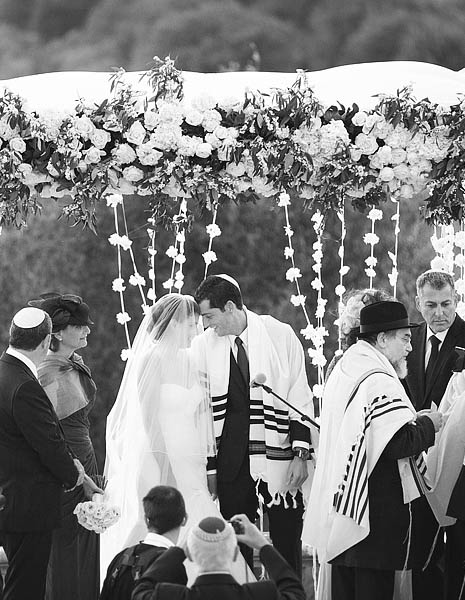
The Chuppah
The Chuppah is one of the most recognizable elements of a Jewish wedding, but its meaning is much greater than its visual importance.
It represents the home the couple will build together.
For an event designer, this requires sensitivity.
The Chuppah should be beautiful, but it should never lose its religious meaning by becoming merely a decorative installation.
Depending on the tradition, venue and Rabbi, it may be created in different ways and with different materials.
At P&J Events, its design is developed in dialogue with the architecture and landscape while respecting the requirements of the ceremony.
In Tuscany, it may frame a view of vineyards and olive groves.
In an historic palace, it may relate quietly to the architecture.
In a synagogue, the existing religious environment naturally takes precedence.
The setting changes.
The meaning does not.
The Ketubah
The Ketubah is the Jewish marriage contract and occupies a central place in the traditional wedding process.
Its wording and form depend on the religious tradition and the authority under which the wedding takes place.
In an Orthodox context, the Ketubah follows established halachic requirements.
In other Jewish traditions, couples may use different forms according to their community and Rabbi.
For international couples, preparation should always be coordinated with the officiating Rabbi well in advance.
P&J Events can help coordinate this process while leaving all questions of religious validity and text to the appropriate rabbinical authority.
From Kabbalat Panim to the Chuppah
Jewish wedding traditions can begin well before the couple stands beneath the Chuppah.
Depending on the community and the wishes of the families, the celebration may include different preparatory customs and moments before the ceremony.
The sequence can include the welcoming of the bride and groom, signing or completion of the Ketubah, family traditions and the procession toward the Chuppah.
Each community has its own customs.
This is why we never assume that one Jewish wedding should reproduce another.
Kiddushin, Rings and the Seven Blessings
At the heart of a traditional Jewish wedding are the moments of Kiddushin and Nissuin.
The ceremony includes blessings over wine, the giving of the ring according to the religious tradition followed by the couple, the reading of the Ketubah and the Sheva Brachot, the Seven Blessings.
These moments have profound religious significance.
For guests unfamiliar with Jewish liturgy, a carefully prepared program or explanation can help them understand what they are witnessing without disrupting the ceremony itself.
Breaking the Glass
The breaking of the glass is perhaps one of the most internationally recognized moments of a Jewish wedding.
Its meaning is much richer than the celebratory reaction that follows it.
Different interpretations exist within Jewish tradition, including remembrance of the destruction of the Temple in Jerusalem even at a moment of great personal happiness.
Immediately afterward, the familiar cry of “Mazel Tov” transforms the conclusion of the ceremony into celebration.
For international guests, understanding this meaning adds enormous depth to the experience.
Yichud
In many traditional Jewish weddings, the couple spends a short period privately together immediately after the ceremony.
Known as Yichud, this moment needs to be considered during venue planning.
A suitable private room should be close enough to the ceremony area while allowing genuine privacy for the couple.
It is a perfect example of how religious knowledge affects logistics.
Without understanding the tradition, a planner may simply forget to provide the appropriate space.
Synagogue Weddings in Italy
Italy has an extraordinary Jewish heritage.
For Orthodox couples in particular, celebrating the wedding in an historic Italian synagogue can create an exceptional connection between the ceremony and centuries of Jewish life in the country.
Florence and Siena offer important synagogue settings in Tuscany, while Venice has one of Europe's most historically significant Jewish quarters and remarkable synagogues.
A synagogue wedding naturally follows the rules of the community and the Rabbi responsible for the synagogue.
Permission, religious documentation and ceremony procedures therefore need to be discussed directly with the relevant Jewish authority.
P&J Events assists international couples in managing that communication and, where necessary, overcoming language and logistical difficulties.
The Great Synagogue of Florence
Florence has one of Italy's most important and visually distinctive synagogues.
For an international Orthodox Jewish wedding, celebrating in Florence can connect the couple not only with the city but with a Jewish community whose history extends over centuries.
The requirements of the synagogue and community must be respected in full.
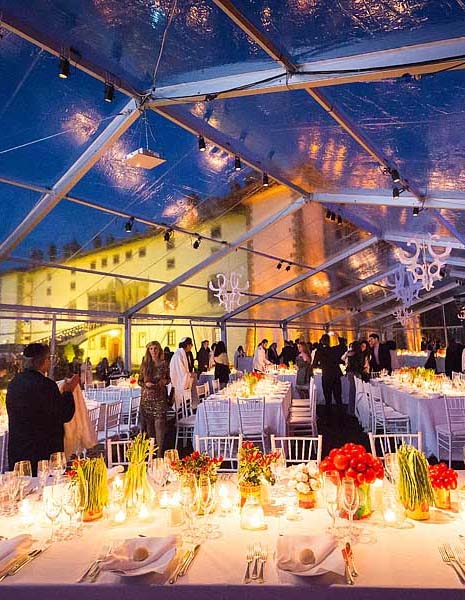
Our role is to coordinate the wedding around those requirements, from guests and transportation to reception logistics, kosher catering and the events surrounding the ceremony.
Jewish Weddings in Siena and Tuscany
Tuscany offers another possibility: combining Jewish religious tradition with one of Italy's most recognizable landscapes.
Depending on the type of ceremony and rabbinical approval, Jewish weddings may be organized in synagogues or in selected private villas, castles and gardens.
A Chuppah overlooking Tuscan hills can be extraordinarily beautiful.
But the visual setting is secondary to ensuring that the ceremony itself corresponds correctly to the couple's religious requirements.
P&J Events works from religion outward, not from decoration inward.
Jewish Weddings in Venice
Venice has a unique place in Jewish history.
The Venetian Ghetto and its historic synagogues create a setting very different from Tuscany.
For couples with an emotional or historical connection to Venetian Jewish heritage, it can be an extraordinarily meaningful destination.
Here again, synagogue regulations, community requirements, guest logistics and the particular complexity of Venice itself must all be planned together.
Orthodox Jewish Weddings
Orthodox weddings require close coordination with the officiating Rabbi and, where relevant, the Jewish community responsible for the synagogue or ceremony.
Religious documentation, the Ketubah, witnesses, Chuppah, kosher arrangements and the precise ceremony structure all need to follow the applicable requirements.
For couples coming from abroad, their home Rabbi may also need to communicate directly with the Italian Rabbi or community.
P&J Events can facilitate this process while respecting the fact that religious decisions belong exclusively to the rabbinical authorities involved.
Reform, Progressive and Other Jewish Weddings
For Reform, Progressive, Conservative, Reconstructionist or other Jewish couples, Italy can offer greater flexibility regarding the setting of the ceremony, depending on the officiating Rabbi and the requirements of the couple's tradition.
A Rabbi may travel with the couple from their home country, or an appropriate Rabbi may be identified in Europe or Italy.
Private villas, gardens, castles and historic properties can provide extraordinary settings for ceremonies when permitted within the chosen religious framework.
Again, we begin by understanding the couple's Jewish identity rather than assuming which ceremony they want.
Legal Recognition of a Jewish Wedding in Italy
Religious validity and civil validity are separate questions and should be considered carefully.
Some Jewish weddings may also produce civil effects in Italy when celebrated according to the applicable legal framework and with the correct documentation and authorized religious arrangements.
Other couples may choose a separate civil ceremony in Italy or complete their legal marriage in their home country.
The correct procedure depends on nationality, residency, type of religious ceremony, officiant and documentation.
P&J Events can assist with the coordination of the civil documentation process, while legal validity must always be confirmed according to the specific circumstances of the couple and the competent authorities.
Kosher Catering
Kosher catering is one of the areas where superficial knowledge can create serious problems.
Kosher does not mean simply avoiding pork or changing several ingredients.
Depending on the required level of kashrut, it can affect the kitchen, equipment, ingredients, wine, meat, dairy products, preparation methods and religious supervision.
P&J Events has extensive experience organizing kosher weddings and working with specialist kosher culinary teams.
Where required, catering operations may involve supervision by Mashgihim and specific standards regarding ingredients and preparation.
We discuss the expected level of observance with the couple and Rabbi before the catering structure is designed.
Kosher Is Part of the Production
The venue must also be compatible with the catering requirements.
If a kosher kitchen must be created temporarily, this affects equipment, work areas, refrigeration, service and production schedules.
The wedding planner therefore needs to understand both the religious requirement and the practical consequences.
This is particularly important in historic Italian villas and palaces where kitchens were never designed for complex contemporary event production.
P&J Events' wider catering and production expertise becomes particularly useful in these situations.
Shabbat and the Wedding Weekend
For observant families, Shabbat can influence the entire structure of the destination wedding weekend.
Timing, transportation, cooking, lighting, music, photography, guest movement and other practical elements may all need to be considered according to the family's level of observance and rabbinical guidance.
Friday dinner, Shabbat services, Kiddush, Shabbat lunch or Seudah Shlishit may also form part of a multi-day Jewish wedding program.
Understanding these requirements from the beginning is essential.
They cannot be added to the event schedule at the last moment.
Jewish Wedding Weekends
Many Jewish destination weddings extend far beyond the ceremony itself.
Families and guests may travel to Italy for several days.
The celebration can therefore include welcome events, Shabbat meals, family gatherings, the wedding ceremony and reception, brunches and other moments together.
Each event can have its own atmosphere while remaining connected culturally and logistically to the wedding as a whole.
This is particularly important when guests arrive from different countries and generations.
Hospitality becomes part of the celebration.
Music and Jewish Tradition
Music has an important role in Jewish weddings and can vary enormously according to the cultural background of the families.
Israeli music, klezmer influences, traditional melodies, contemporary Jewish music and international repertoire may all appear within the same celebration.
The Hora and other forms of celebratory dancing can also have a significant impact on the way the reception is designed.
Space, furniture, music and timing need to allow these moments to happen naturally rather than being forced into a generic wedding schedule.
Culture Is Not Decoration
One of the principles behind P&J Events is that cultural traditions should never be treated as styling.
The Chuppah is not a decorative arch.
The Ketubah is not a prop.
Kosher is not a menu theme.
Shabbat is not a scheduling preference.
These elements belong to a religious and cultural tradition that deserves to be understood before it is incorporated into an event.
This is why we place so much importance on cultural knowledge.
Luxury, in this context, means getting the meaning right.
Jewish Families from Around the World
Over more than two decades, we have worked with Jewish couples and families coming to Italy from different parts of Europe, Israel, the United States and other international communities.
This has taught us that Jewish identity can be both universal and extraordinarily personal.
One family may place enormous importance on strict Orthodox observance.
Another may identify strongly with Jewish culture while following a progressive religious tradition.
One family may have Sephardi customs.
Another Ashkenazi.
Some couples bring different traditions together within the same marriage.
A knowledgeable planner should recognize these distinctions rather than flatten them into a generic idea of a “Jewish wedding.”
From Regency to P&J Events
Our work with Jewish weddings began during the historic Regency years.
The collaboration developed with Rabbis, Jewish communities, kosher specialists and international families, including the long-standing professional relationship established with Rav Joseph Levi during his years as Chief Rabbi of Florence.
Today the brand is P&J Events.
The relationships, cultural knowledge and practical experience developed through those years remain part of our work.
This continuity matters because genuine expertise in religious and cultural weddings cannot be created overnight.
It is accumulated through people, experience, relationships and respect.
The Role of P&J Events
P&J Events does not decide Jewish law.
We do not replace the Rabbi or the Jewish community.
Our expertise is in understanding enough to know what must be asked, who must decide it and how those religious requirements affect every other aspect of the wedding.
We coordinate with the Rabbi.
We communicate with the synagogue.
We understand the implications of kosher production.
We know that Shabbat can change an event schedule.
We understand why the Chuppah matters.
We recognize that different communities may have different customs.
And we translate all of that into the practical reality of organizing an international destination wedding in Italy.
That combination of cultural knowledge, religious sensitivity and event-production experience is what P&J Events brings to a Jewish wedding.
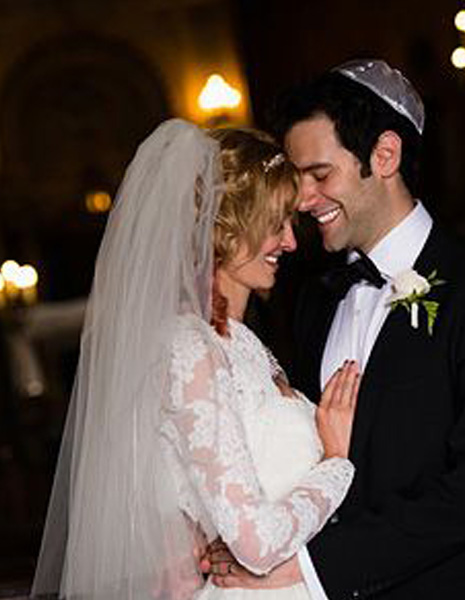
YOUR WEDDING IN ITALY BEGINS HERE
Effortless, Beautiful, Unforgettable.