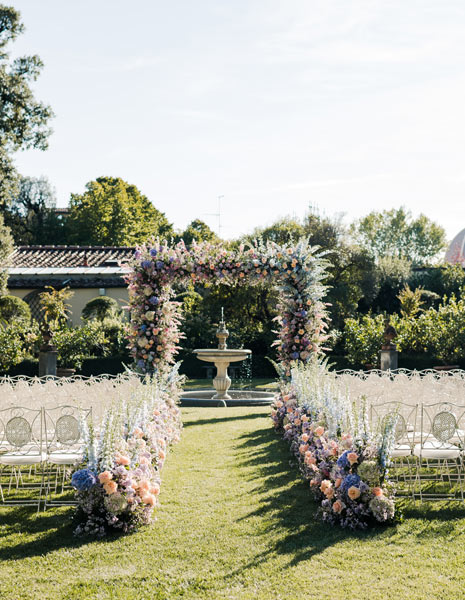
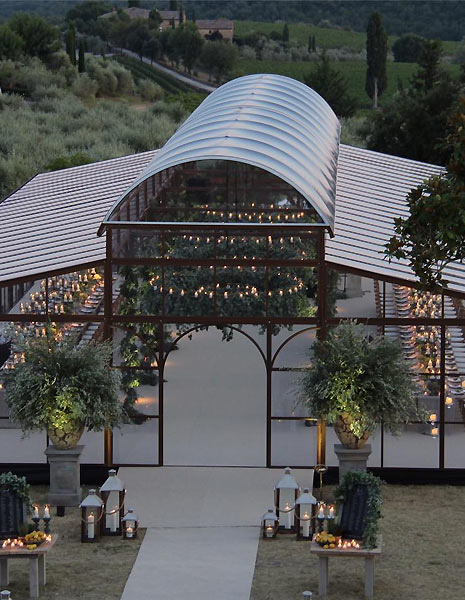
Luxury Wedding Villas in Italy
Weddings in Italy
Wedding Villas in Italy
Italy has no single idea of a wedding villa.
The word villa can describe a Renaissance residence in Tuscany, an eighteenth-century estate in Veneto, a Baroque aristocratic property in Sicily, a lakefront residence, a monumental garden villa, a Mediterranean house overlooking the sea or a contemporary architectural property created for modern hospitality.
They may all be called villas.
They create completely different weddings.
For this reason, at P&J Events we do not begin venue research by asking which villa is the most famous or which one photographs best.
We begin by understanding the couple, the number of guests, the character of the wedding, the atmosphere they want to create, the level of privacy required, whether accommodation is important and how the property must function during the event.
Only then does the search truly begin.
Since the early Regency years, starting in 1987, researching, visiting and understanding Italian villas has been one of the foundations of our work.
That knowledge continues today under the P&J Events brand.
Over more than three decades, our team has personally researched and catalogued more than 6,000 villas throughout Italy.
We have worked directly in more than 2,000 of them.
And across more than 6,000 weddings and events, we have been able to understand not only what these properties look like, but how they actually behave when they become working environments for a real event.
This distinction is essential.
YOUR WEDDING IN ITALY BEGINS HERE
Effortless, Beautiful, Unforgettable.
Wonderful Villas for a Wedding in Italy
What It Really Means to Know a Villa
Today it is easy to obtain photographs, videos, floor plans and prices of almost any wedding venue.
For us, that is not enough.
Knowing a villa means having stood inside it.
It means understanding how guests arrive, where suppliers enter, how far the kitchen is from the dining area, whether trucks can reach the property, how furniture moves through the building and what happens if rain changes the event plan at the last moment.
It means knowing where the sun falls at dinner time.
Where the wind is strongest.
Which rooms remain cool in summer.
Which lawns become difficult after heavy rain.
How many guests the bathrooms can really support.
How late music can continue.
Whether a bus can turn safely.
Whether a temporary kitchen can be installed.
Whether the indoor alternative is genuinely suitable for the same number of guests.
And, above all, it means knowing which problems can be solved easily and which ones will inevitably affect the event.
That kind of knowledge cannot be obtained from a brochure.
It is acquired through years of site inspections, production meetings and real weddings.
More Than 6,000 Villas Personally Researched
Since the 1990s, the Regency team developed a method based on direct inspection.
The objective was never simply to collect names of beautiful properties.
Each villa was studied as an event environment.
Architecture.
Access.
Guest capacity.
Gardens.
Rooms.
Catering infrastructure.
Bathrooms.
Electrical supply.
Music restrictions.
Parking.
Accommodation.
Rain alternatives.
Service routes.
Production access.
Local regulations.
Over time this created an extensive internal knowledge base.
Today, under P&J Events, Paolo, Jinane and the team continue the same process.
New villas are still visited personally.
Existing properties are revisited because management changes, spaces are restored, rules evolve and what was true ten years ago may no longer be true today.
For each property, the team develops technical information based on direct observation and experience.
The result is a working database of more than 6,000 villas personally researched throughout Italy.
More Than 2,000 Villas Used for Real Events
There is another level of knowledge that begins only after a wedding actually takes place.
More than 2,000 of the villas in our database are properties in which our organization has worked directly.
That means we have seen them during real events.
Not during an empty site inspection.
Not during a marketing presentation.
During weddings.
We have seen kitchens operating under pressure.
Guests arriving simultaneously.
Rain changing a dinner plan.
Music moving from outdoors to indoors.
Production teams loading late at night.
Catering service crossing long distances.
Historic plumbing coping with hundreds of guests.
Transport arriving on narrow roads.
Gardens under heavy event use.
This is where theoretical knowledge becomes practical knowledge.
More Than 6,000 Weddings and Events
Across more than three decades, our organization has planned and produced more than 6,000 weddings and events.
That volume of experience matters not because of the number itself, but because each event has added information.
Every wedding reveals something about the property in which it takes place.
A room may perform better than expected.
A terrace may become uncomfortable in certain wind conditions.
A particular rain solution may work beautifully.
A service route may prove too slow for a large dinner.
A neighbor may impose sound restrictions.
A garden may support a structure only in specific areas.
Over time, these details become a body of knowledge that cannot be replicated by simply searching for venues online.
Our Database Is Not a Directory
A venue directory lists properties.
Our database is different.
It includes what we have learned about them.
The difference is fundamental.
A directory can tell you that a villa accommodates 200 guests.
Experience tells you whether 200 guests can actually dine comfortably, circulate properly, use the bathrooms without difficulty, move indoors if it rains and continue dancing without compromising service.
A directory can tell you that a villa has a kitchen.
Experience tells you whether that kitchen can actually support the catering required for the event.
A directory can tell you that music is permitted.
Experience tells you until what time, at what level and under which conditions.
A directory describes.
Experience interprets.
Villas Created Primarily for Events
Some Italian villas are extraordinary because of their architecture, history and landscape rather than because they provide accommodation.
These are often properties whose principal value lies in the setting itself.
Villa d’Este in Tivoli is one of the greatest expressions of the Italian Renaissance villa and garden.
Villa Valguarnera in Bagheria represents the extraordinary aristocratic culture of Sicilian villa architecture.
Villa Barbarigo at Valsanzibio combines an important historic residence with one of Italy's most remarkable monumental gardens.
The villas of the Riviera del Brenta reflect the centuries-old relationship between Venetian aristocracy, countryside estates and the waterways connecting Venice with the mainland.
Properties such as these already possess an extremely strong identity.
For a wedding, the objective is not to create a character for the villa.
It is to understand the character that is already there.
Villas with Accommodation
Another important category is formed by villas capable of hosting both the event and the couple or their guests.
This changes the wedding completely.
The villa becomes more than the setting for a single evening.
It becomes the temporary home of the wedding.
Breakfasts.
Poolside afternoons.
Family lunches.
Welcome dinners.
Informal gatherings.
The wedding itself.
Farewell brunches.
The experience can continue for several days.
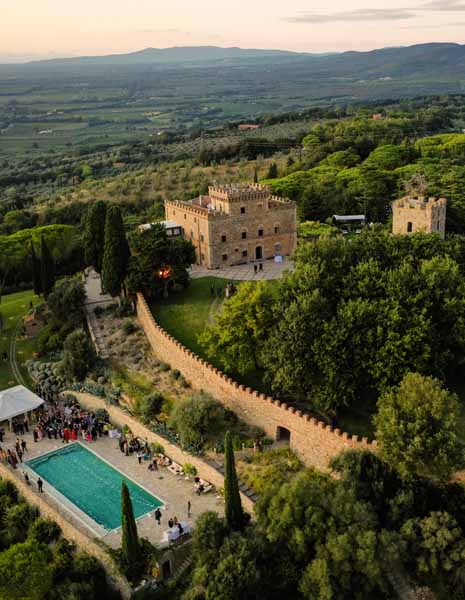
This model is particularly common in Tuscany, Umbria and many other Italian regions where Renaissance, Baroque and nineteenth-century country residences have been restored and adapted for sophisticated hospitality.
Accommodation also changes logistics significantly.
If the couple and their closest guests are staying on site, transportation can be reduced.
The property becomes more private.
The wedding feels less like an event people arrive at and more like a place they inhabit together.
Event-Only Villa or Residential Villa?
Neither model is inherently better.
They create different experiences.
An event-only villa may offer architecture, scale, gardens or historical prestige that would be impossible to reproduce in a residential property.
A villa with accommodation may provide intimacy, privacy and a stronger sense of living together over several days.
The correct question is not:
“Which one is more luxurious?”
It is:
“Which one is right for this wedding?”
Renaissance Villas
Renaissance villas are among the most distinctive expressions of Italian architecture.
In Tuscany in particular, they often combine proportion, symmetry, garden and landscape with remarkable restraint.
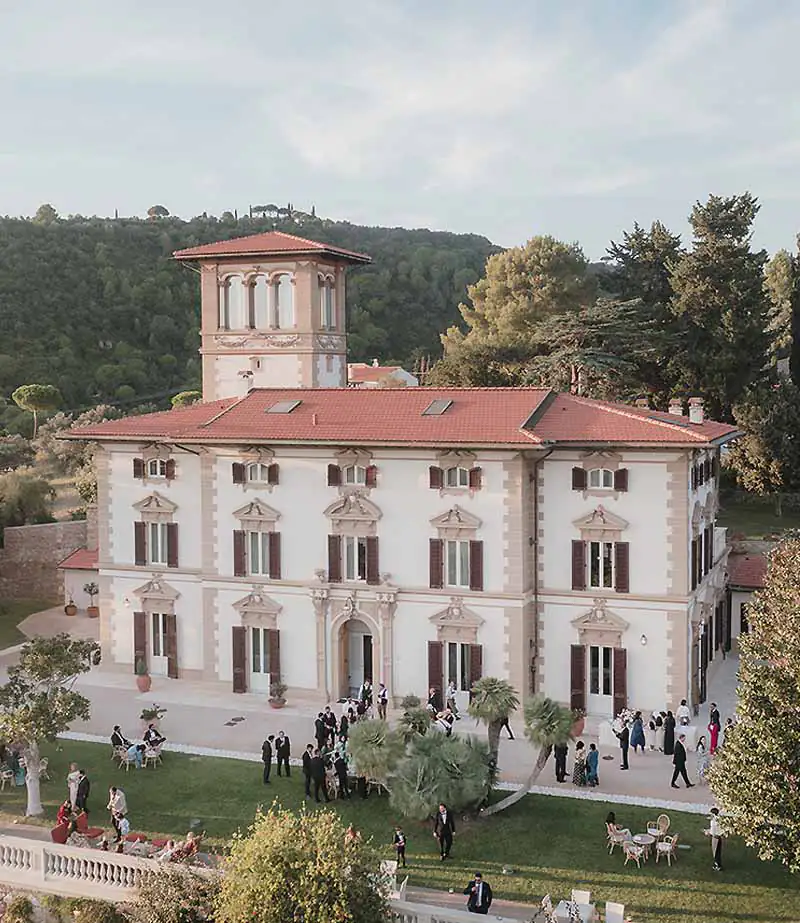
Villa I Collazzi near Florence is a good example of this architectural language.
Its strength lies not in excessive decoration, but in the relationship between architecture and surrounding landscape.
A Renaissance villa often creates an atmosphere of balance, order and elegance.
For couples looking for sophistication without theatrical excess, this type of architecture can be exceptionally powerful.
Baroque Villas
Baroque villas speak an entirely different language.
In Sicily, particularly around Bagheria and Palermo, great aristocratic villas developed with a far more theatrical approach to space and decoration.
Curved forms.
Grand staircases.
Movement.
Ornament.
Perspective.
The architecture itself can become part of the drama of the wedding.
A Baroque villa is therefore not simply a more decorated version of a Renaissance villa.
It creates a different emotional experience.
Venetian Villas
The villas of Veneto form another architectural family.
Many developed between the Renaissance and the eighteenth century as country residences of Venetian families.
Along the Riviera del Brenta and elsewhere, villa, garden, agricultural land and waterways often form one coherent composition.
Their atmosphere combines representation, leisure and connection to the landscape.
For weddings, this creates extraordinary possibilities, particularly when the property includes formal gardens, monumental approaches and strong relationships between indoor and outdoor spaces.
Tuscan Villas
Tuscany has perhaps the widest international recognition for villa weddings.
But even within Tuscany, the category is extremely broad.
Renaissance villas around Florence.
Country estates surrounded by vineyards.
Historic residences in Chianti.
Properties near Siena.
Villas in Val d’Orcia.
Coastal estates.
Restored farmhouses.
Each creates a different wedding.
The word “Tuscan villa” alone tells us very little.
The architecture and operational characteristics matter much more.
Umbrian Villas
Umbria offers a different relationship between villa, countryside and historic towns.
Many properties have a stronger sense of privacy and landscape and can be particularly suitable for multi-day destination weddings.
Restored estates may combine historic architecture with accommodation, making them attractive for couples who want family and close friends to remain together for several days.
Sicilian Villas
Sicily offers extraordinary contrasts.
Historic aristocratic villas around Palermo and Bagheria.
Country estates.
Properties overlooking the sea.
Contemporary residences.
Mediterranean gardens.
The cultural influences of the island create settings very different from those found in central or northern Italy.
For couples seeking architecture with strong identity, Sicily can be exceptional.
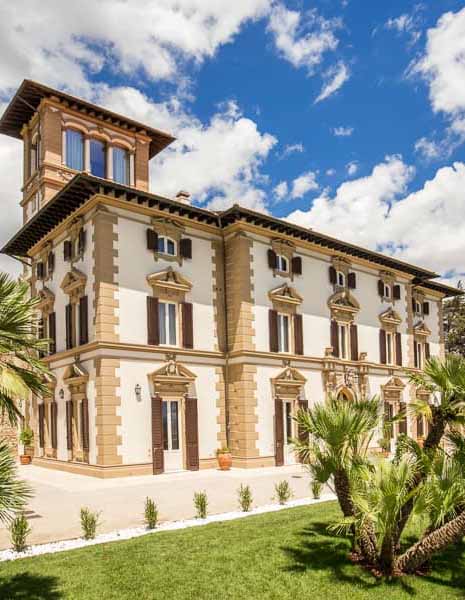
Contemporary Villas
Italy also offers an increasing number of contemporary villas.
Sardinia, Sicily, southern Tuscany, the Roman coast and other areas include exceptional modern properties designed around views, open spaces, glass, stone, landscape and sophisticated hospitality.
These villas often combine accommodation and event spaces more easily than historic properties.
Technical infrastructure can also be stronger.
For couples seeking a clean, architectural and contemporary aesthetic, this category may be more appropriate than an historic residence.
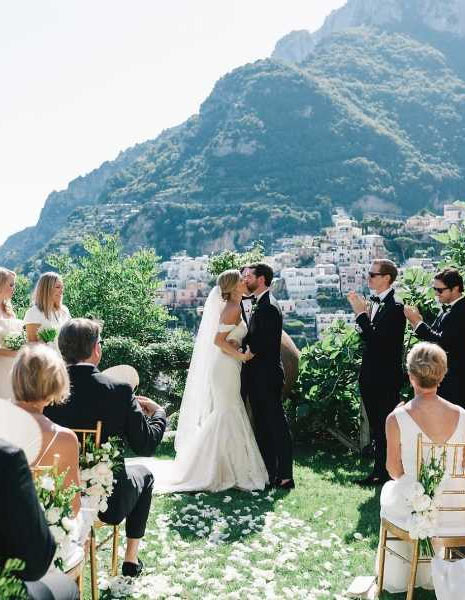
Villas by the Sea
A villa overlooking the Mediterranean creates an immediate relationship between wedding and landscape.
Amalfi Coast.
Sardinia.
Sicily.
Liguria.
Italian islands.
The beauty can be extraordinary.
But coastal villas also introduce specific considerations.
Wind.
Humidity.
Salt.
Road access.
Transport.
Supplier movement.
Sound restrictions.
Temperature.
A spectacular view alone is never enough to determine whether the property is right.
Lake Villas
Lake Como, Lake Garda and the other Italian lakes offer another distinct villa culture.
Historic residences often combine formal gardens, water access and dramatic landscapes.
Boat arrival can become part of the wedding experience.
But lake venues also require careful consideration of transportation, weather, wind, docking, guest movement and Plan B.
The Architecture Should Belong to the Wedding
A villa should never be treated as a neutral shell.
Its architecture already communicates something.
A restrained Renaissance villa does not speak the same language as a Sicilian Baroque residence.
A nineteenth-century lake villa does not communicate the same emotion as a contemporary Sardinian property.
The strongest weddings are those in which the architecture, design, flowers, lighting, furniture and atmosphere appear naturally connected.
This does not mean avoiding contrast.
Contemporary design can work beautifully inside historic architecture.
But contrast should be deliberate.
The venue should not be selected for its identity and then forced to pretend it is something else.
A Practical Guide to Evaluating an Italian Wedding Villa
Plan B
The outdoor plan is only half of the venue.
The first question should always be:
What happens if it rains?
A true Plan B should accommodate the same number of guests with comparable dignity and comfort.
A magnificent garden with an inadequate indoor alternative can be a serious risk.
Music Until Late
The beauty of a villa does not guarantee that music can continue outdoors until late.
Neighbors.
Municipal regulations.
Local ordinances.
Venue rules.
Indoor alternatives.
These can all affect the party.
If dancing late into the night is important, this must be verified before the property is booked.
Wedding Flow
A wedding is a sequence.
Ceremony.
Aperitif.
Dinner.
Cake.
Dancing.
The architecture should support this progression naturally.
Guests should not feel as if they are constantly being moved through inconvenient routes.
The best villas reveal different spaces gradually.
Guest Capacity
The number advertised by the venue is only the beginning.
True capacity includes:
comfortable dinner seating, circulation, bathrooms, service routes, dance floor, rain plan, production, catering, and emergency access.
Bathrooms
Historic villas often have beautiful bathrooms designed for private residential use.
That does not automatically mean they can support 150 or 200 guests using them continuously.
Plumbing capacity, drainage and maintenance access matter.
When necessary, discreet luxury temporary restroom facilities may be the professional solution.
Catering
A villa may have a kitchen.
That does not mean it has an event kitchen.
Professional catering may require temporary kitchens, additional electricity, water, refrigeration and service areas.
The distance between kitchen and tables also has a major impact on service quality.
Supplier Access
Flowers, furniture, catering, sound, lighting and production equipment all need to reach the event area.
Narrow roads, stairs, historic floors, protected gardens and limited loading areas can affect feasibility and cost.
Guest Transport
A remote villa can create extraordinary privacy.
It can also require sophisticated transportation planning.
Coach access.
Turning space.
Parking.
Night-time departures.
Elderly guests.
All must be considered.
Accommodation
If accommodation is available, the quality and number of rooms should be evaluated in relation to the guest profile.
Accommodation within the villa can reduce transportation and increase privacy, but only if it genuinely suits the people expected to stay there.
View
A view is not merely decorative.
It affects timing, orientation and design.
Sunset.
Sun exposure.
Wind.
Guest positioning.
Photography.
A spectacular view should become part of the event rather than remain simply a background.
Gardens and Monumental Parks
Historic parks may contain protected trees, sculptures, fountains, irrigation systems and fragile lawns.
Structures cannot always be placed wherever they appear visually ideal.
Landscape restrictions must be understood before design begins.
Knowing the Advantages and the Limitations
There is no perfect villa.
Every property has strengths and weaknesses.
A great planner should know both.
One villa may have extraordinary architecture but complex access.
Another may have excellent accommodation but strict sound restrictions.
Another may provide spectacular gardens but a weaker Plan B.
Another may have the perfect dinner space but require significant temporary catering infrastructure.
The purpose of professional advice is not to hide these limitations.
It is to explain them clearly so that the couple can make an informed decision.
Legally Valid Civil Weddings in Italian Villas
One of the most distinctive possibilities offered by P&J Events is the organization of legally valid civil wedding ceremonies in Italian private villas.
Through experience developed over decades, first under Regency and today under P&J Events, we have created procedures that allow us to assist couples who want their official civil marriage to take place directly in the villa chosen for the wedding.
This possibility is not limited to a small predetermined list of properties.
P&J Events can evaluate and organize the process for private villas throughout Italy, subject to the applicable Italian law, the cooperation of the relevant municipality and the authorizations required for the specific property and ceremony.
This means that when a couple falls in love with a particular villa, the first question does not necessarily have to be:
“Is this already an official town-hall wedding venue?”
Our team can examine the legal and administrative possibilities and determine whether the civil ceremony can be made valid within that setting.
A Civil Ceremony in the Villa You Actually Chose
This creates an important difference.
Many international couples are otherwise asked to organize a legal ceremony at a town hall or approved municipal venue and then celebrate a second symbolic ceremony at the villa.
Where the legal and administrative conditions can be established, P&J Events can instead work toward bringing the legally valid civil ceremony into the private villa itself.
The result is one ceremony.
In the setting the couple actually chose.
With immediate civil validity according to the procedure applicable to that wedding.
Private Civil Ceremonies Throughout Italy
Our experience with civil ceremonies extends throughout Italy.
The precise process depends on the municipality, the villa, the nationality of the couple and the legal documentation involved.
For this reason every case is studied individually.
P&J Events coordinates the process with the relevant authorities, property and couple so that the legal requirements and event planning develop together.
This is one of the areas in which decades of direct experience in Italian destination weddings provide a particularly significant advantage.
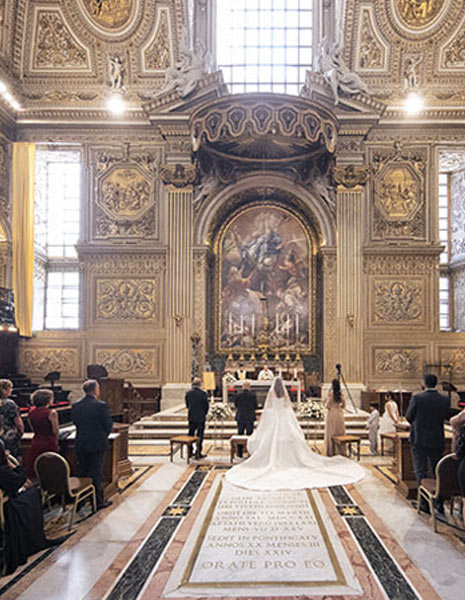
Protestant, Jewish and Symbolic Ceremonies in Villas
Private Italian villas can also provide exceptional settings for Protestant weddings, Jewish ceremonies, non-denominational celebrations and symbolic weddings.
Each type of ceremony brings different requirements.
A Jewish wedding may involve a Chuppah, Ketubah, kosher production and specific religious considerations.
A Protestant wedding may involve an authorized Minister and, under the appropriate circumstances, may also have legal validity.
Symbolic ceremonies allow far greater freedom of structure and content.
In every case, the villa must support both the ceremony itself and the practical requirements around it.
Villas with Accommodation and the Destination Wedding Experience
When the villa includes accommodation, the wedding can become a true destination experience.
Guests no longer experience Italy only during the ceremony and reception.
They live there.
Breakfast together.
Afternoons by the pool.
Walks.
Informal lunches.
Welcome dinners.
The wedding day.
The morning after.
For international families, these unplanned moments often become some of the most memorable parts of the celebration.
Villas Without Accommodation Can Be Equally Extraordinary
An event-only villa can offer something different.
A monumental garden.
An extraordinary historical interior.
Architecture impossible to reproduce in a residential property.
A spectacular ceremonial atmosphere.
In these cases, accommodation and transportation are organized separately.
The additional logistics may be worthwhile because the setting itself brings a unique cultural or architectural value to the wedding.
Choosing Between Them
The decision therefore depends on priorities.
If the couple wants everyone together for several days, accommodation may be central.
If the primary objective is architectural prestige, a particular garden or a historic setting, an event-only villa may be the stronger choice.
Neither model defines luxury.
The correct relationship between couple, architecture and experience does.
Why P&J Events Knows Italian Villas
Since 1987, venue research has been part of our professional identity.
During the Regency years, the team began traveling throughout Italy to visit properties directly because even then we understood that a villa could not be evaluated through photographs alone.
Today Paolo, Jinane and the P&J Events team continue the same approach.
We visit.
We inspect.
We take notes.
We record technical information.
We return.
We compare.
And when we organize an event in a villa, we learn even more.
After more than thirty years, this has created one of the deepest bodies of practical knowledge of Italian wedding villas available to an international client.
Our Numbers Reflect Experience, Not a Catalogue
More than 6,000 villas personally researched.
More than 2,000 villas in which we have worked directly.
More than 6,000 weddings and events organized across more than three decades.
For us, these numbers do not represent volume.
They represent accumulated knowledge.
Every property has taught us something.
And that knowledge allows us to explain to a client not only why a villa is beautiful, but whether it is right.
The Right Villa
The right villa is not necessarily the most famous.
It is not necessarily the most expensive.
It is not always the one with the largest garden or the widest view.
It is the one in which architecture, atmosphere, logistics, guest experience and the couple’s vision come together naturally.
That is what P&J Events looks for.
Click here for more Italian Venues.