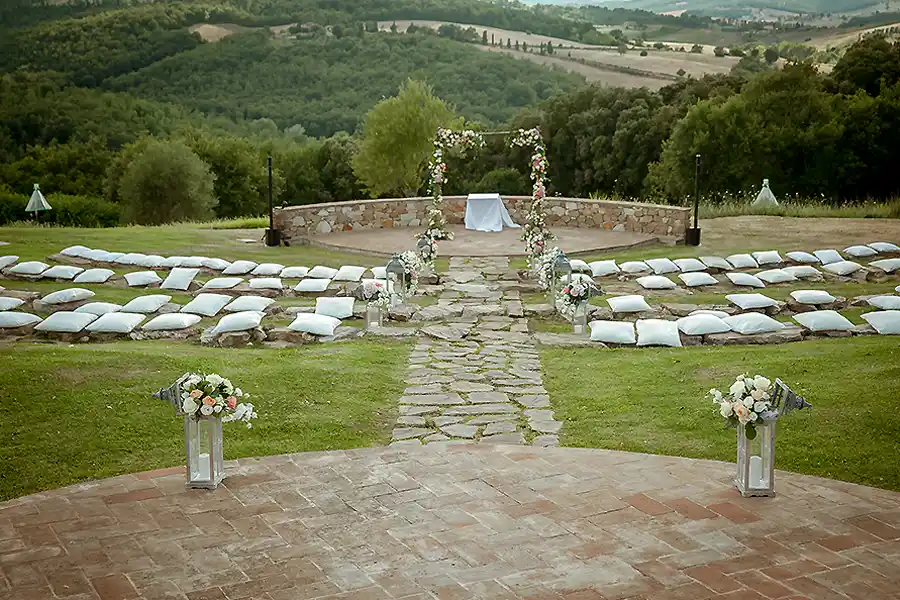
Wedding Settings in Italy
How to Choose a Venue by Understanding What a Place Really Is
P&J Events brings professional venue research experience in Italy dating back to 1987. Over nearly four decades, we have researched, visited, selected and worked in wedding and event locations throughout the country.
Over nearly four decades, this has created something very different from a collection of beautiful venues.
It has created knowledge.
Knowledge of historic palaces, castles, villas, gardens, private estates, monasteries, hotels, country houses, beaches, islands and contemporary spaces.
Knowledge of what these places communicate aesthetically and culturally.
And, just as importantly, knowledge of what happens when they stop being beautiful photographs and become working environments for a real event.
P&J Events is known for the depth of its knowledge of Italian venues and settings because venue research has always been at the heart of our work.
We do not consider a location simply according to its appearance.
We study what it means, how it works, what it allows, what it prevents and for which type of event it is genuinely suitable.
This distinction is fundamental.
A wedding venue is not a neutral container.
The moment a place is chosen, a large part of the wedding has already been decided.
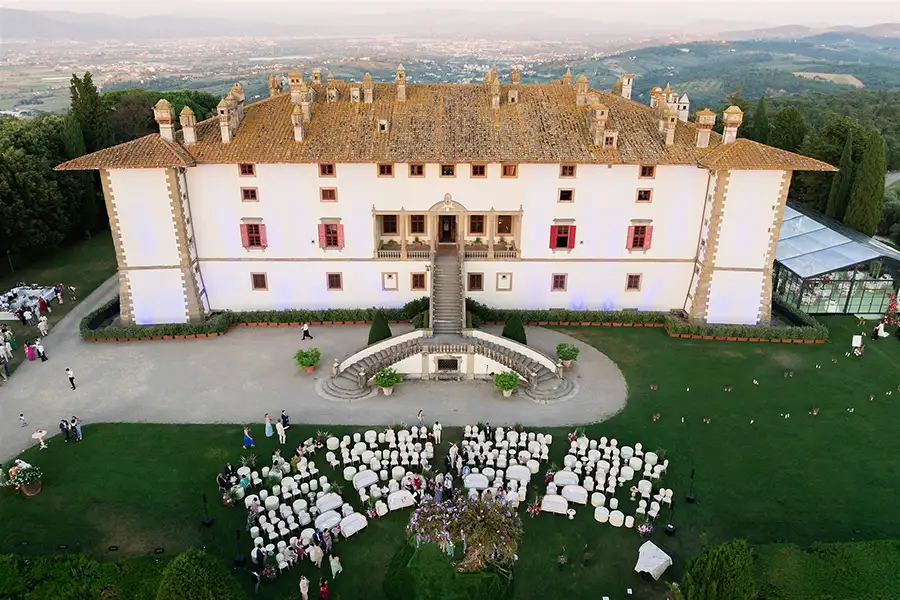
The Setting Comes Before the Decoration
A medieval castle and a Venetian Baroque palace may both be extraordinary.
But they cannot create the same wedding.
One may communicate sobriety, permanence, protection, stone, history and a certain severity.
The other may communicate ceremony, ornament, theatricality, color, movement and grandeur.
Neither is superior.
The question is whether the language of that place corresponds to the meaning the couple wants the wedding to have.
This is why we prefer the word setting to the simpler word venue.
A venue is a physical property.
A setting is the relationship between architecture, history, landscape, culture, atmosphere and the event that will take place there.
Choosing the setting is therefore one of the first creative decisions of the entire wedding.
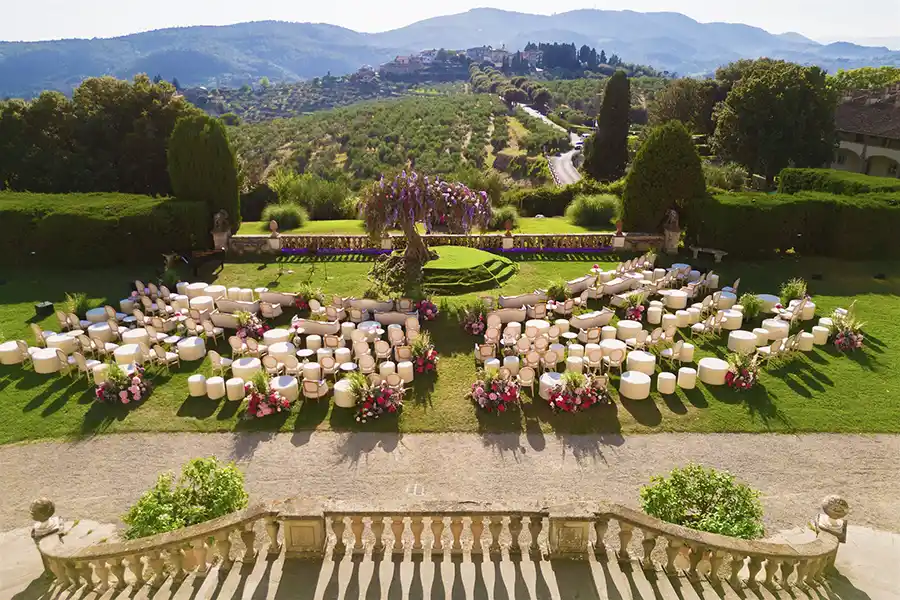
A Place Already Has an Identity Before We Arrive
Historic buildings are not empty.
They already contain centuries of architectural decisions, materials, proportions, social conventions and cultural meaning.
A Renaissance villa has a different rhythm from a medieval fortress.
A Roman palazzo does not communicate the same values as a masseria in Puglia.
A garden designed around perspective, fountains and symmetry creates a different emotional response from a wild Mediterranean landscape.
This is not a matter of style alone.
Places affect the way we behave inside them.
They influence how formal we feel, how we move, how we speak, how we gather and even how we perceive time.
The Romans described the character of a place through the idea of the genius loci, the spirit of the place.
It remains an extraordinarily useful concept for event design.
A successful wedding rarely ignores the genius loci.
It recognizes it.
Harmony Does Not Mean Imitation
Working with the identity of a place does not mean reproducing its historical period.
A contemporary event can be extraordinary inside a historic palace.
Minimal design can work beautifully in ancient architecture.
Contrast can be sophisticated.
But there is an important difference between contrast and contradiction.
If a couple chooses a highly ornate Venetian Baroque palace and then spends enormous effort trying to make the building disappear in order to reproduce the atmosphere of a severe contemporary gallery, one has to ask whether the correct setting was chosen in the first place.
The same principle works in reverse.
A modest rural property can lose much of its natural beauty when forced to imitate the ceremonial language of a grand aristocratic palace.
The strongest design usually begins by understanding what the place already offers and deciding consciously whether to continue that language, simplify it or create an intelligent counterpoint.
It should never begin by pretending that the architecture is not there.
Choosing a Setting Means Choosing a Direction
Couples often begin venue research by saving images of many completely different places.
A castle.
A villa overlooking the sea.
A Tuscan estate.
A Venetian palace.
A contemporary hotel.
A garden.
All may be beautiful.
But beauty alone does not make them interchangeable.
At a certain point, choosing the setting means narrowing the field.
This is not a limitation.
It is the beginning of a coherent project.
If the couple understands that they want privacy, landscape, informality and a strong relationship with nature, certain categories immediately become more relevant and others less so.
If they want ritual, architecture, ceremony and historical grandeur, the search moves in another direction.
Good venue selection does not consist of seeing an endless number of beautiful properties.
It consists of progressively understanding which type of place belongs to the wedding.
The Question Is Not “Which Venue Is Best?”
There is no best venue in absolute terms.
There is a best venue for a particular event.
The same property can be perfect for one wedding and completely unsuitable for another.
A castle that creates extraordinary intimacy for 80 guests may become uncomfortable with 250.
A villa that is exceptional for a dinner under the stars may become problematic if its indoor alternative cannot accommodate the same number of guests.
A palace that is perfect for a formal celebration may be a poor choice for a couple who wants an informal party lasting until dawn.
A spectacular location may therefore be the wrong location.
Understanding this before signing a contract is one of the most valuable parts of professional venue consulting.
Architecture Has Practical Consequences
There is another reason why the history of a building matters.
Architecture reflects the period in which it was created.
Historic properties were not built for contemporary events.
A Renaissance palace was not designed for refrigeration trucks, modern catering equipment, sound systems, generators, staging, temporary kitchens, DJs, hundreds of guests arriving simultaneously or technical production teams working through the night.
A medieval castle was not designed with accessibility standards, freight elevators or wide service corridors.
These limitations do not make historic venues unsuitable.
On the contrary, they are often precisely what makes them extraordinary.
But they must be understood.
The character of a historic property and its logistical limitations come from the same architecture.
You cannot separate one from the other.
We Look at a Venue Differently
When a client enters a beautiful palace, it is natural to notice the frescoes, ceiling heights, garden, view and atmosphere.
We see those things too.
But at the same time, after decades of events, we are automatically looking at something else.
We are looking at the width of the doors.
The staircase.
The electrical supply.
The distance between the kitchen and the dining area.
The possibility of moving equipment without damaging historic floors.
The route guests will follow after dark.
Where catering trucks can stop.
Whether a bus can turn.
How furniture reaches the upper floor.
Where musicians load in.
What happens if it rains.
Whether the bathrooms can sustain the number of guests.
Whether the location that looks perfect at 11 a.m. during a site inspection will still work at midnight with 180 people, a catering team, musicians and production operating simultaneously.
That is the difference between visiting a venue and understanding it.
Bathrooms: The Kind of Problem Nobody Notices Until It Is Too Late
Bathrooms are a perfect example.
A client visits a Renaissance villa and sees several elegant bathrooms.
It seems obvious that the issue is solved.
But the existence of a bathroom does not tell us whether the plumbing system was designed for intensive use by 150 or 200 people over many hours.
Historic systems may have limited drainage, water pressure or waste capacity.
A bathroom designed for occasional private use can become a serious problem when used continuously by a large number of guests.
If the system fails during the wedding, what looked like a minor technical issue becomes an immediate problem for everyone.
The professional solution may be to install high-quality temporary restroom facilities in a discreet service area.
This is precisely the type of decision that should be made before the event.
Good planning often consists of solving problems the guests will never know existed.
Real Capacity Is Not the Number Written on a Brochure
A venue may advertise capacity for 200 guests.
That number alone tells us very little.
Can 200 people dine comfortably?
Can they circulate?
Is there a credible indoor solution for all of them if it rains?
Are there sufficient bathrooms?
Can the catering team serve that number efficiently?
Is there enough electrical power?
Can guests move safely from dinner to dancing?
Where will suppliers work?
Where will coats be stored?
Where will cars and buses go?
Capacity should be evaluated as a functioning system, not as the mathematical number of chairs that can be fitted into a room.
Access Can Determine the Entire Production
Some of Italy's most extraordinary venues were intentionally built in places that are difficult to reach.
Hilltops, islands, historic city centres, narrow medieval streets and remote countryside are part of their beauty.
They are also part of their logistics.
A road that is perfect for a car may be impossible for a coach.
A doorway that is generous for a guest may not allow production equipment through.
A historic staircase may make it impossible to transport certain furniture.
A protected lawn may prevent a truck from reaching the place where a temporary structure must be built.
A venue should therefore be evaluated not only according to how guests enter but according to how the entire event enters.
The Garden Is Architecture Too
One of the most common misconceptions is that a large garden represents unlimited freedom.
Historic and monumental gardens can actually be among the most complex environments in which to produce an event.
Trees, protected roots, underground irrigation, slopes, fountains, sculptures, drainage and historic landscaping can determine where structures, kitchens, generators, lighting and furniture can be installed.
A lawn may appear empty but be subject to restrictions on vehicles or anchoring.
A beautiful park may require long service routes because suppliers cannot cross protected areas.
The landscape is therefore not simply scenery.
It is part of the architecture of the event.
Even the Ground Matters
Marble, gravel, grass, sand, historic brick and stone each produce consequences.
A gravel courtyard may be beautiful but difficult for certain shoes, wheelchairs and catering carts.
Grass may require flooring beneath dining tables after rain.
Historic stone may limit the type of structures that can be installed.
A beach introduces sand, wind and salt.
These are not reasons to reject a setting.
They are reasons to understand it.
The Plan B Is Part of the Venue
We never evaluate an outdoor location only according to what happens in perfect weather.
The correct question is not:
“Can we dine in this garden?”
The correct question is:
“What is this wedding if we cannot?”
A beautiful Plan A and an unacceptable Plan B do not constitute a good venue solution.
The alternative space should be studied with exactly the same seriousness as the preferred one.
Can it accommodate the guests?
Does it preserve the quality of the event?
Does it require completely different furniture or production?
Can the transition happen quickly if the weather changes?
A couple should know the answers before signing the venue.
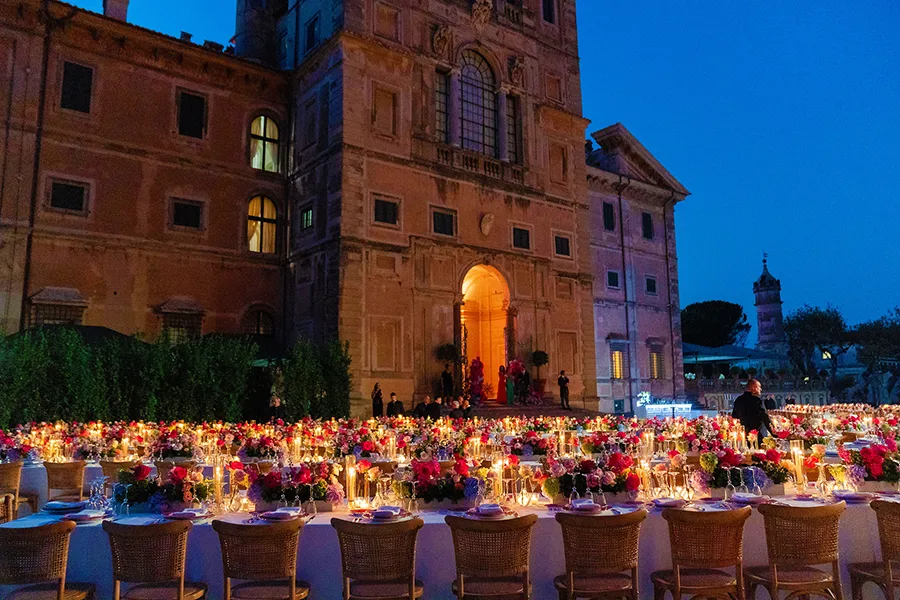
Weather Means More Than Rain
Heat can be more problematic than rain.
So can wind.
Humidity.
Cold.
Strong afternoon sun.
Mosquitoes.
A beautiful terrace facing west may provide an exceptional sunset while becoming almost unusable for an hour before sunset during summer.
A lake can offer extraordinary views but experience significant temperature changes after dark.
A coastal location may create wind conditions that affect flowers, candles, sound and temporary structures.
The setting and the season must always be considered together.
Music Can Decide Whether a Venue Is Right
One of the questions that should be asked very early is what happens after dinner.
Many couples imagine dancing outdoors late into the night.
Not every location allows it.
Historic properties may have neighbors.
Municipal regulations may limit decibel levels or outdoor music after a certain hour.
Some venues require parties to move indoors.
Others have no suitable indoor dance space.
This does not make the venue inferior.
It simply means it may not be right for a wedding in which the late-night party is central to the experience.
Catering Reveals Whether a Venue Really Works
Guests see the dining room.
Caterers see everything behind it.
Where is the kitchen?
Is it large enough?
Is there sufficient electricity?
Water?
Refrigeration?
Dishwashing?
Waste removal?
How far must waiters walk from kitchen to table?
Do they cross guest areas?
Are there stairs?
Can hot food reach 180 guests quickly enough?
The quality of a caterer cannot compensate indefinitely for inadequate infrastructure.
Understanding the operational side of food service is therefore a fundamental part of venue evaluation.
An Event Is a Sequence, Not a Single Room
A wedding evolves.
Guests arrive.
They attend the ceremony.
They move to cocktails.
Then dinner.
Cake.
Dancing.
Perhaps an after-party.
The quality of the setting depends partly on how naturally these moments connect.
The movement from one area to another creates rhythm.
A good venue can reveal itself gradually.
A courtyard leads to a garden.
A garden opens toward a terrace.
Dinner gives way to another room for dancing.
Architecture becomes part of the event choreography.
When this sequence works, guests experience the event almost without thinking about logistics.
That apparent effortlessness usually requires careful planning.
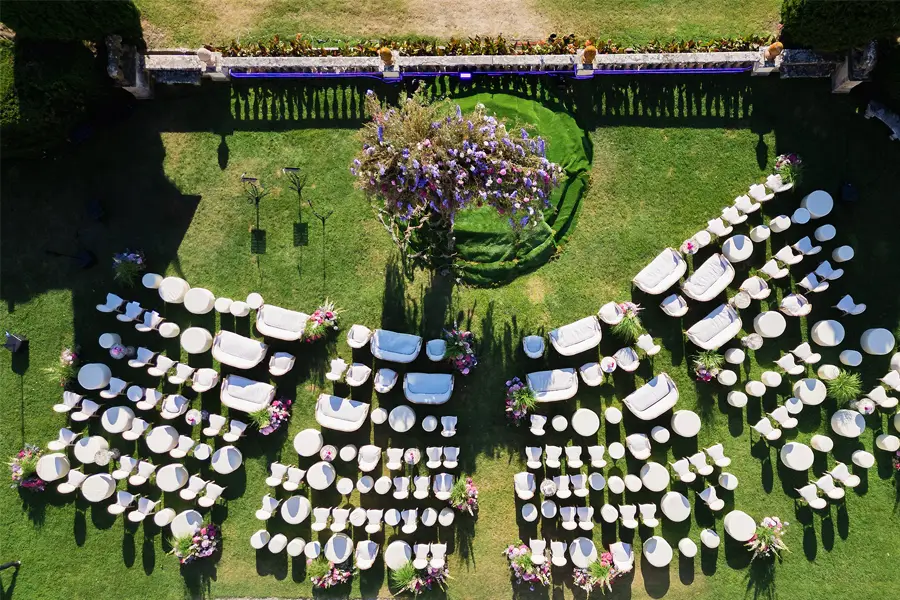
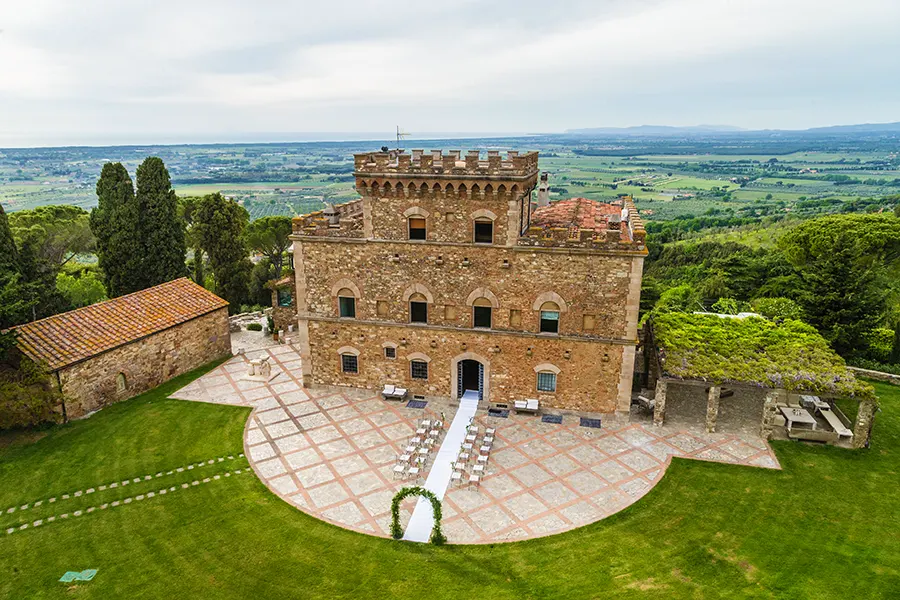
Castles
A castle immediately carries historical and symbolic weight.
Stone, walls, towers and courtyards suggest permanence, history, protection and strength.
For some couples, this emotional language is precisely what they want.
But castles can also bring narrow entrances, irregular floors, stairs, limited electrical infrastructure, difficult access and complex production routes.
The same architecture that gives the venue its extraordinary character determines its practical limits.
A castle should therefore be chosen because its identity belongs to the wedding, not simply because the word “castle” sounds romantic.
Historic Palaces
Palaces speak another language.
They were designed to represent power, culture, wealth and ceremony.
Their sequence of rooms, frescoes, chandeliers, marble, paintings and proportions already provides a powerful decorative environment.
This is why a palace often requires less intervention than couples initially imagine.
The challenge is usually not how to fill it.
It is how to respect it.
Historic flooring, protected walls, limited loading access, small service areas, sound restrictions and existing architecture must be understood before design begins.
Villas
The Italian villa is one of the most versatile wedding settings.
It can combine architecture, garden, landscape and residential intimacy.
But the word “villa” can describe very different realities.
Some villas have been professionally adapted for events.
Others remain essentially private residences occasionally rented for weddings.
Two properties that look similar in photographs can therefore perform very differently when 150 guests, catering and production arrive.
The operational history of the property matters as much as its architecture.
Gardens and Parks
A great garden can become the architecture of the wedding.
Trees define ceilings.
Paths determine movement.
Fountains and sculpture create focal points.
Landscape provides perspective.
When a garden is strong enough, decoration can become more restrained because much of the visual experience already exists.
But gardens also require careful study of weather, ground, electrical supply, lighting, accessibility, protected vegetation and Plan B.
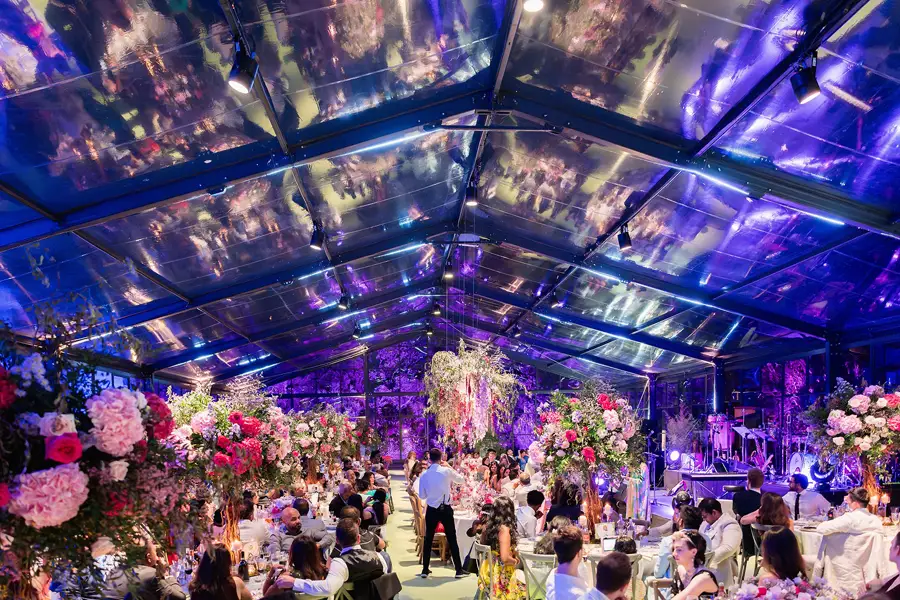
Countryside Estates
Tuscan estates, farmhouses, vineyards, olive groves and rural properties create a completely different relationship between the event and the place.
They can communicate authenticity, food, landscape, informality and connection with the land.
But countryside also brings distance.
Transport planning, accommodation, roads, parking and late-night departure become especially important.
Isolation may be one of the location's greatest emotional qualities and one of its most significant logistical challenges.
Seaside and Island Settings
The sea changes everything.
Light, wind, humidity, salt, temperature and access become part of the event.
A coastal property may produce extraordinary emotional impact but require more technical discipline than an inland venue.
Islands add another consideration: almost everything may need to arrive by boat.
Production schedules, suppliers, emergency alternatives and guest transport become central to the planning.
Contemporary Settings
Historic architecture is not the correct answer for every couple.
Contemporary buildings, modern hotels, industrial conversions and architectural spaces can offer a completely different freedom.
Clean lines, technical infrastructure and flexible interiors may allow design to play a stronger role because the building itself communicates less historical narrative.
For couples who want a highly contemporary visual language, this can be an advantage.
Again, the correct choice depends on what the event is intended to mean.
Sacred Architecture
Churches, chapels, monasteries and religious buildings require another type of sensitivity.
Their meaning is not primarily decorative.
The architecture expresses ritual and spirituality.
This often means that relatively little additional decoration is necessary.
Understanding the cultural and religious significance of the setting is more important than imposing an external design language upon it.
P&J Events and the Knowledge of Italian Settings
Venue research has been part of our professional work since 1987 and continues today under P&J Events.
During those years, properties were not selected through online directories.
They were discovered through travel, personal relationships, site inspections, local knowledge and direct experience.
We visited places before they were widely known as wedding venues.
We saw properties change management.
We saw venues improve.
We saw others become more difficult.
We learned which spaces work differently according to season, guest count and type of event.
That body of knowledge grew year after year.
Today it continues under P&J Events.
The name has evolved, but the method has not.
We still believe that a location cannot be understood from photographs and a price list.
It has to be known.
A Database Cannot Replace Experience
Today, anyone can search hundreds of Italian wedding venues online.
This has made discovery easier.
It has not necessarily made selection easier.
A database can tell you where a property is located, how many rooms it has and perhaps its stated capacity.
It cannot tell you whether dinner service becomes slow because of the distance from the kitchen.
It cannot explain how the courtyard feels when completely filled with tables.
It does not know whether coaches struggle on the last kilometer of road.
It cannot tell you what happens to the garden after two days of rain.
It cannot explain which room actually works for dancing.
It cannot tell you how management responds when something goes wrong.
These things are learned by working in venues.
That accumulated knowledge is one of the most important resources P&J Events brings to venue selection.
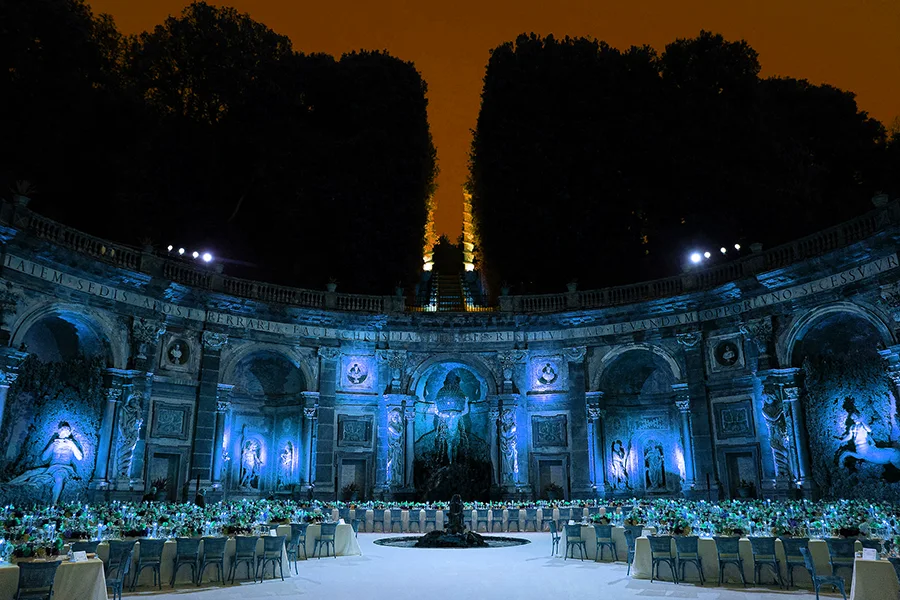
Our Approach to Venue Selection
When we help a couple select a setting, we consider the place as a whole.
The architecture.
Its historical and cultural meaning.
The emotional response it creates.
Its relationship with the concept of the wedding.
The real number of guests it can accommodate comfortably.
The ceremony.
Dinner.
Party.
Plan B.
Catering.
Bathrooms.
Technical infrastructure.
Accessibility.
Transportation.
Accommodation.
Music restrictions.
Production.
And the countless small practical details that determine whether the event will feel effortless or complicated.
Only when all of these aspects are considered together can a venue be evaluated properly.
The Right Setting Is the One That Makes the Wedding More Natural
A truly appropriate venue reduces the need to force the event.
The design begins to make sense.
Flowers belong.
Lighting emphasizes what is already there.
Furniture relates naturally to architecture.
Guest movement becomes easier.
The emotional language of the celebration and the emotional language of the place begin to reinforce each other.
This is what we look for.
Not simply the most famous venue.
Not necessarily the most expensive.
Not the one currently appearing most often on social media.
The right one.
Frequently Asked Questions
A venue is the physical location. A setting includes the architecture, history, landscape, atmosphere, cultural meaning and logistical characteristics of that location and the way all of these elements influence the event.
Begin with the kind of experience you want to create rather than with a list of properties. Understanding whether the wedding should feel intimate, monumental, relaxed, historic, contemporary, theatrical or immersed in nature helps identify the correct categories of settings.
Usually yes. The setting provides a visual and cultural framework for the event. Design is generally stronger when it develops in dialogue with the architecture rather than being created independently and then imposed upon it.
Absolutely. Contrast can be sophisticated and contemporary. The important distinction is between deliberate contrast and design that simply ignores or fights against the architecture.
It refers to the particular spirit and identity of a place. Architecture, landscape, history, materials and culture combine to create qualities that influence how a venue is perceived and experienced.
Capacity should be evaluated according to the complete event: ceremony, cocktails, dinner, service, bathrooms, circulation, dancing, technical requirements and Plan B. The number published by a venue should never be considered in isolation.
They were built for the requirements of another period. Narrow entrances, stairs, historic flooring, limited electrical systems, small kitchens, plumbing and access restrictions can all affect a modern event.
Existing bathrooms may not have been designed for continuous use by a large number of guests. For larger events, additional high-quality restroom facilities can sometimes protect both the property and the guest experience.
Essential. A venue should be judged not only according to the preferred outdoor plan but according to what the wedding becomes if weather makes that plan impossible.
No. Our objective is to identify the right setting for the client. Our knowledge includes a wide range of properties throughout Italy, and venue evaluation is based on suitability for the individual event.
Yes. A location does not need to have been proposed by us. We can analyse a property selected by the couple and assess its architectural, aesthetic, logistical and operational suitability for the planned wedding.
Researching and selecting locations has been part of our professional work since 1987. Over nearly four decades, direct site inspections and real events have created a depth of practical knowledge that goes far beyond information available in venue directories or online listings. Today that experience continues under the P&J Events brand.
Choosing the Setting
The purpose of venue research is not to find the place that impresses most quickly.
It is to find the place that remains right after every question has been asked.
A location should make sense aesthetically.
Historically.
Culturally.
Emotionally.
Technically.
Logistically.
When all these dimensions align, the setting stops being the background of the wedding.
It becomes part of its meaning.
That is how P&J Events has approached venue selection since 1987.
And it is still how we choose a setting today.
YOUR WEDDING IN ITALY BEGINS HERE
Effortless, Beautiful, Unforgettable.